This is a very sensitive post as all others on this website, but this is written specifically for those going through the hold of an addiction that is detoriorating to the spirit, soul and body. so make sure you share this insight with someone who needs it or anyone who might just have someone who needs help.
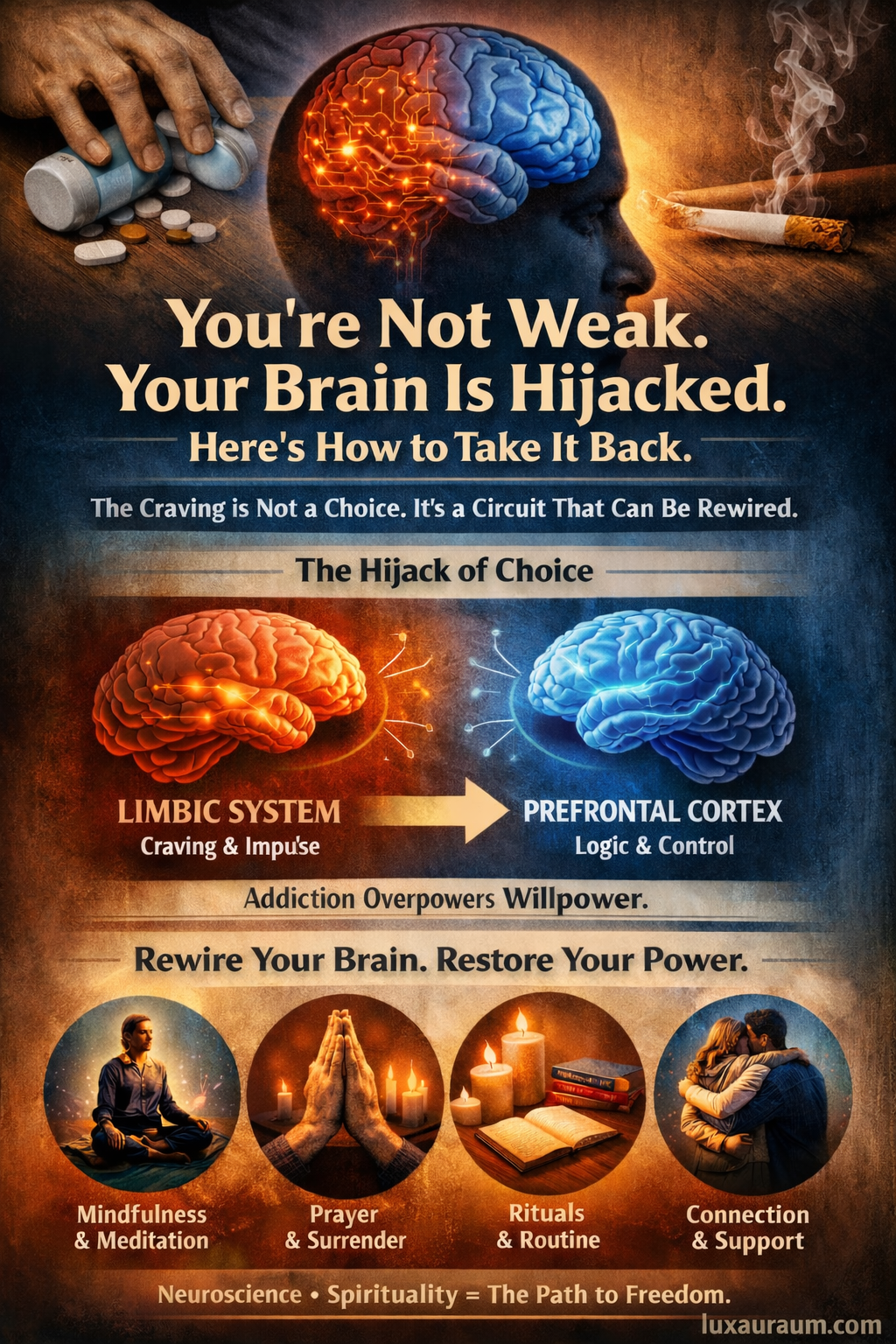
Every addict knows the feeling: you don't want to do it, but something in you is already reaching. The decision happens before you decide. The craving is not a choice—it's a circuit. And circuits can be rewired.
You've tried to stop. Maybe a substance. Maybe a behavior. Maybe something that started as escape and became a prison. You know it's harming you. You want to stop. But in the moment, something stronger than your will takes over.
You've been told it's a moral failure. Lack of discipline. Weak character. You've been shamed, blamed, told to pray harder, try harder, be stronger.
But here's the truth that changes everything:
Addiction is not a weakness. It is a hijacked brain. Your reward circuits have been captured by something that promises relief but delivers destruction. And the way out is not just willpower—it is understanding the mechanism and building new pathways.
Addiction is a disorder of the brain's reward system. Dopamine, the chemical of motivation and pursuit, gets rerouted to the substance or behavior. Over time, the brain rewires itself to prioritize the addiction above all else—food, relationships, survival itself.
The good news: the same neuroplasticity that created the addiction can also heal it. Spiritual practices—mindfulness, prayer, meditation, ritual—are not just "coping mechanisms." They are direct tools for rewiring the brain's reward circuits and reclaiming choice.
WHAT ACTUALLY HAPPENS IN THE BRAIN
The Reward Circuit
Your brain has a reward system designed to keep you alive. When you eat, drink, connect with others, or achieve a goal, the brain releases dopamine. This creates the feeling of motivation, satisfaction, and the desire to repeat the behavior.
[Neuroscience note: Dopamine is not pleasure. It is wanting. It drives you toward things that the brain has learned are rewarding. This is why addicts don't necessarily enjoy their addiction anymore—but they still crave it.]
How Addiction Hijacks the System

The Hijack of Choice
The prefrontal cortex (PFC) is the brain's "executive"—responsible for planning, impulse control, and long-term thinking. The limbic system (including the amygdala) is the brain's "impulse"—responsible for emotion, craving, and immediate reward.
In addiction, the limbic system overpowers the PFC. The decision happens before you decide. By the time your conscious mind says "no," the impulse has already acted.
[Neuroscience note: This is why willpower alone fails. The brain's decision-making centers are literally being overridden by stronger, more ancient circuits. You are not weak. Your brain is in a tug-of-war, and the addiction has the stronger rope.]
CRAVING VS. CHOICE
What Craving Is
Craving is not a moral failure. It is a learned neural response. When you encounter a cue associated with your addiction—a time of day, a place, an emotion, a smell—the brain releases dopamine in anticipation of the reward. This creates the experience of craving.
Craving is the brain saying: "I remember this. This was rewarding. Do it again."
What Choice Is
Choice is the prefrontal cortex saying: "I know that will harm me in the long run. I will not do it."
But when the limbic system is screaming, the PFC can't be heard. The goal of recovery is not to eliminate craving—it is to strengthen the PFC's ability to say no and to retrain the brain's reward system to find satisfaction in healthy behaviors.
SPIRITUAL PRACTICES AS CRAVING MANAGEMENT
Here is what the ancient traditions knew: spiritual practices are not just about connection with the divine. They are technologies for retraining the brain.
1. Mindfulness of Craving
Buddhist tradition teaches mindfulness of craving—not to fight it, but to observe it. When you notice craving arising, you simply notice: "This is craving. It will rise and pass."
[Neuroscience note: Mindfulness activates the prefrontal cortex and calms the amygdala. When you observe craving without acting on it, you are literally strengthening the PFC's ability to override the limbic system. Each time you ride out a craving, the neural pathway of self-control gets stronger.]
Practice: When craving arises, pause. Breathe. Say to yourself: "This is craving. I do not have to act on it. It will pass." Observe it like a wave. It rises, peaks, and falls. You are still there after it passes.
2. Prayer and Surrender
Twelve-step programs (Alcoholics Anonymous, Narcotics Anonymous) teach surrender: admitting that you cannot control the addiction on your own and turning to a Higher Power.
[Neuroscience note: Surrender is not passivity. It is releasing the mental loop of self-blame and shame, which keeps the stress response active. When you stop fighting and accept, the nervous system can settle. This allows the PFC to function again.]
Practice: When you feel the grip of addiction, say: "I cannot do this alone. I release this to something greater than me." This is not giving up. It is giving over.
3. Ritual and Routine
Jewish, Christian, Islamic, and other traditions emphasize daily prayer, meditation, and ritual. These are not just obligations—they are structures that replace the addiction's routine.
[Neuroscience note: The brain's basal ganglia (habit center) runs on routine. Addiction is a deeply ingrained habit loop. Replacing it with a new routine—morning prayer, evening meditation, weekly ritual—uses the same habit machinery to build something healthy.]
Practice: Create a daily ritual that occurs at the same time you used to use. Morning prayer. Evening gratitude. A walk in nature. The key is consistency. The habit loop will learn a new pattern.
NEUROPLASTICITY-FRIENDLY ROUTINES
Neuroplasticity is the brain's ability to change. The same mechanism that carved the addiction pathway can carve a new one. Here's how:
1. Delay
When craving hits, delay. Even five minutes. Even one minute. Each delay weakens the craving circuit and strengthens the self-control circuit.
Practice: Set a timer. Say: "I will not act for five minutes." Then do something else. Walk, breathe, drink water. When the timer ends, set it again.
2. Displace
The brain's reward system needs something to pursue. If you remove the addiction without replacing it, the craving will intensify.
Practice: Find a healthy behavior that activates the reward system. Exercise, creative work, meaningful connection, spiritual practice. Not as a punishment—as a genuine replacement.
3. Distract with Intention
Distraction alone is escape. Distraction with intention is redirection.
Practice: When craving hits, deliberately engage in something that requires focus. A puzzle. A conversation. A physical task. Not to "not think about it"—to activate a different neural pathway.
4. Connect
Addiction thrives in isolation. Connection releases oxytocin, the bonding chemical, which naturally reduces stress and craving.
Practice: Reach out to someone you trust. Not necessarily to talk about the addiction—just to connect. A phone call. A meeting. A shared meal.
5. Sleep
Sleep deprivation impairs the prefrontal cortex and amplifies craving.
[Neuroscience note: Even one night of poor sleep can reduce PFC function by 20-30%. In recovery, sleep is not optional—it is foundational.]
Practice: Prioritize sleep. Set a regular bedtime. Create a wind-down ritual. The brain heals itself during sleep.
WHAT THE SCRIPTURES SAY
Across traditions, the battle against addiction is described in spiritual language—but the mechanism is the same.
The Talmud (Sukkah 52b)
"A person's evil inclination rises every day and seeks to kill them."
The "evil inclination" is not a demon—it is the brain's automatic impulse toward immediate reward. The Talmud teaches that the only way to overcome it is to study Torah—to engage the mind in something higher.
The Apostle Paul (Romans 7:15-20)
"I do not understand what I do. For what I want to do I do not do, but what I hate I do... I have the desire to do what is good, but I cannot carry it out."
Paul describes the split between intention and action—the prefrontal cortex wanting good, the limbic system pulling toward the old pattern. His conclusion: freedom comes not by willpower but by surrender to a Higher Power.
The Qur'an (2:168)
"Do not follow the footsteps of Satan. Indeed, he is to you a clear enemy."
"Satan" here represents the patterns that lead to self-destruction. The warning is to recognize the path before you are on it.
The Bhagavad Gita (6:5)
"One must elevate oneself by one's own mind, not degrade oneself. The mind is the friend of the conditioned soul, and its enemy as well."
The same mind that creates addiction can also heal it. The question is which master it serves.
THE ROLE OF SHAME—AND WHY IT MUST GO
Shame is the enemy of recovery. When you believe you are weak, worthless, or beyond help, the brain's stress response activates. Stress increases craving. The cycle deepens.
[Neuroscience note: Shame activates the same threat circuits as physical danger. When you are in threat mode, the PFC shuts down and the limbic system takes over. You literally cannot think clearly when you are ashamed. This is why shame-based approaches to addiction fail.]
The spiritual alternative: Repentance (teshuvah) is not shame. It is turning. It is acknowledging the wrong path and choosing a new one. It requires self-compassion, not self-hatred.
Psalm 51:17 says: "The sacrifices of God are a broken spirit; a broken and contrite heart, O God, You will not despise."
Not shame—humility. The recognition that you cannot do it alone is the beginning of freedom.
THE PATH—STEP BY STEP
If you are struggling with addiction, here is a path forward:
1. Acknowledge
You cannot heal what you deny. Say it out loud: "I am struggling with this. It is bigger than me. I need help."
2. Separate Self from Behavior
You are not your addiction. Your brain has learned a pattern. Patterns can be unlearned.
3. Seek Connection
Find someone you can tell the truth to. A trusted friend. A spiritual guide. A support group. Isolation is the addiction's best friend.
4. Build a New Routine
Replace the addiction's habits with spiritual practices. Same time, same place, new behavior. The habit loop will learn.
5. Practice Mindfulness of Craving
When craving hits, pause. Observe. Ride the wave. Each time you do, the circuit weakens.
6. Surrender
You cannot do this alone. Release the outcome. Trust that there is something greater than your addiction—call it God, the universe, your higher self—that can hold what you cannot.
7. Be Patient
Neuroplasticity takes time. The addiction pathway was built over months or years. The new pathway will take months to strengthen. Do not give up.
A Note on Mystery: The neuroscience in this post describes what happens in the brain during addiction. The reward circuits, the hijacked choice, the neuroplasticity of recovery—these are real, measurable, and powerful.
But they do not exhaust the mystery of addiction.
The person in the grip of addiction is not just a brain with a hijacked circuit. They are a soul in pain, seeking relief, trapped in a pattern that once promised freedom. The spiritual traditions knew this. They spoke of demons, of the yetzer hara (evil inclination), of Satan, of Mara—not because they denied the biology, but because they knew that addiction touches the deepest parts of a person.
The language of spirituality and the language of neuroscience are not opposed. They are two ways of describing the same struggle. The addiction is real. The suffering is real. And the path to freedom—through awareness, through connection, through practice, through surrender—is real in both languages.
Remember share this to every platform you know to help someone out there.








Collective Insights
Be the First to Share
Your insights could spark meaningful conversations. Share your thoughts above!
Share Your Insight