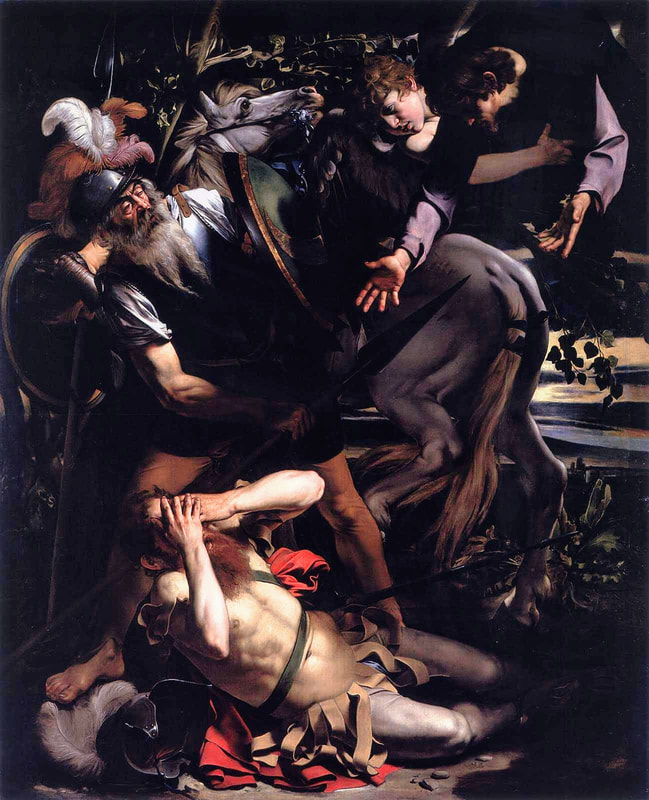
Biblical Context (Acts 9:1–31, KJV):
Saul, a fierce persecutor of Christians, was traveling to Damascus when he encountered the risen Jesus in a blinding light. Jesus confronted him, saying, “Saul, Saul, why persecutest thou me?” Struck blind, Saul was led into Damascus, where a disciple named Ananias later healed him. In that moment of surrender, Saul asked, “Lord, what wilt thou have me do?” His encounter marked a complete transformation—he converted, became known as Paul, and began preaching Jesus as the Christ.
You feel a growing, unnamed tension between who you are and who you’re becoming. Your old life—your career, your relationships, your beliefs—feels like a suit that no longer fits, but you’re afraid to take it off because you don’t know what’s underneath. You’re successful but empty, comfortable but haunted. A part of you is begging for a revolution, while another part is terrified of what that revolution might destroy. You’re walking your own road to Damascus, and you can feel the destination approaching like a storm.

The Damascus event is not a biblical story. It is the universal template for radical spiritual awakening. It is not about conversion to a religion. It is about conversion of consciousness.
The road to Damascus is not geography. It is a psychic corridor—the path the unawakened soul walks until the current turns inward and the self collapses upon itself. A road is fate made visible. Saul was not traveling toward a city. He was traveling toward annihilation of identity.
The road is your current life path—the one built by your ego, your conditioning, your fear. You are Saul, the rigid identity, traveling confidently toward a destination that no longer exists. The blinding light is not divine grace—it is inescapable self-truth. It is the moment your carefully constructed self-image shatters under the direct gaze of what you really are. It is not gentle. It is psychic surgery without anesthetic.
The blinding light was not mercy. In occult language, light is exposure. It is the unveiling of everything the ego hides from itself. When Saul was struck, the architecture of his identity was illuminated in a single violent instant. No psyche survives full self-exposure without fracture. Thus, he fell. Collapse is the first gate.
Blindness was the sacrifice demanded for vision. In shadow gnosis, outer perception must recede so inner perception may dominate. Darkness is the womb of insight. Saul’s blindness marked the sealing of the external world and the opening of the inner abyss where symbols, memories, and archetypal forces rule. Loss of sight is the reorientation of consciousness away from illusion toward the inner mechanics of being.
The voice was not comfort. It was command. Sound without form is authority without body—the emergence of a dominant organizing principle within the mind. The question, “Why do you persecute me?” was the psyche interrogating itself, confronting the internal war between identity and its latent transformation.
Saul’s name was a structure of will, law, and egoic rigidity. To rename him was to erase the former architecture. In occult initiation, the old name is destroyed because identity is the prison of the soul. A new name is a new vibration, a new narrative, a new alignment with forces hidden in the unconscious substrate.
The new name is not a label. It is a new vibrational signature. 'Paul' did not improve upon 'Saul.' He replaced him. Your old name carries the karma of your past. The new name is the soul's declaration of sovereignty over a reformed identity.
The three days of blindness are not punishment. They are the necessary void. When the external world is taken from you—when your roles, your validation, your familiar thoughts are stripped away—you are forced into the inner abyss. Here, in the absolute dark, the old self dissolves. This is Nigredo—the alchemical putrefaction. The ego must die so the essence can emerge.
The three days of darkness were the Abyssal Interval. In alchemy, this is Nigredo—the sacred decomposition of meaning. In this void, belief systems dissolve, narratives collapse, and the self becomes fluid. Consciousness is stripped to raw awareness, awaiting reassembly.
Fasting was not discipline. It was deprivation of the ego’s anchors. When the body weakens, habitual identity loosens. Hunger destabilizes the self-model and summons buried impulses, fears, and powers. Ananias was not merely a healer. He was a stabilizer. His touch grounded the reorganized consciousness so it would not fragment into madness or prophecy. In forbidden traditions, uncontained awakening destroys the vessel.
Ananias is not a person. He is the stabilizing force of integration. He represents the part of your soul that knows how to touch the raw, exposed nerve of your new consciousness and say: "You are not mad. This is your birth." Without this grounding, awakening leads to psychosis or paralysis. You must have a hand to guide you from the tomb.
The transformation was not moral. It was ontological. Saul did not become righteous. He became other. His consciousness shifted from external law to internal symbolic fire, from doctrine to direct experience, from rigid identity to dynamic essence. The Christ-force was not a man—it was a dominant archetypal pattern reorganizing perception, memory, and meaning.

The Ritual of Voluntary Collapse
You cannot wait for the lightning to strike you. The initiate invites the lightning. This is the controlled demolition of the former self.
The Operation:
The Summoning of the Light (The Truth Invocation):
At midnight, stand before a mirror with a single candle lit beside you. Look into your own eyes until the face becomes strange. Speak aloud, clearly:
“I invoke the Light That Reveals. Not to comfort me, but to dismantle me. Show me the architecture of my own prison. I consent to the collapse.”
Extinguish the candle. Sit in total darkness. Let every identity—your name, your resume, your story—float before you like discarded masks. Do not cling to any of them. This is the blinding.
The Descent into the Three-Day Tomb (The Abyssal Interval):
For the next 72 hours, observe a fast from identity.
Fast from validation: No social media. No seeking approval.
Fast from narrative: Do not explain yourself, even in your own mind.
Fast from comfort: Engage only in necessary, mindful action.
Carry a small, smooth stone in your pocket. When you feel the panic of the dissolving self, grip it. It is your only anchor. You are in the blindness. Your job is not to see, but to be dissolved.
The Arrival of Ananias (The Integration Touch):
On the dawn of the fourth day, perform the Ritual of the New Name.
Go to a natural body of water—a river, lake, or the sea. Hold your stone. Speak all the old names you have carried: “The Victim,” “The People-Pleaser,” “The Achiever,” whatever they are. Cast the stone into the water with each name, releasing it.
Then, submerge your hands. As you pull them out, dripping, whisper:
“I am ______.”
Let the name come. It may be a word, a sound, a sensation—not a legal name, but a soul title. This is Ananias touching your eyes. This is the grounding of the new vibration.
Walking as the Reborn
The ritual initiates the death. Now you must live the resurrection.
The Daily Unlearning: Each morning, identify one thread of the old Saul that still tries to weave itself into your day. It could be an automatic thought (“I must be productive to have value”), a reflex (apologizing when not at fault), or a fear (of conflict, of lack). Consciously sever it. Do the opposite, however small. You are systematically deconstructing the ghost of the former self.
Building the New Vessel: The old you was a fortress. The new you must be a temple. For 40 days, perform one daily action that is authentic but unfamiliar. If the old you was rigid, introduce spontaneous beauty. If the old you was chaotic, institute sacred order. This is not self-improvement. This is vessel-building for the consciousness that was born in the dark.
The Apostolic Test: The true test of a Damascus initiation is what you are compelled to teach. Paul did not hide. He spoke from the fire. Find one person, one situation, where you can express one fragment of your new truth, without needing to be believed. This grounds the mystical into the manifest. Your message is not doctrine; it is the evidence of your transformation.
All other spiritual practices ask you to improve the self you already know. They decorate the prison.
The Damascus Initiation works because it annihilates the prisoner.
You are not polishing Saul. You are allowing Saul to be struck down so Paul can rise. This is not metaphor. This is ontological revolution—a change in the very nature of your being.
The blindness is essential because vision is attachment. When you cannot see the old world, you cannot crave it.
The voice is essential because truth must be auditory before it can be structural. The command reorganizes the psyche from within.
The new name is essential because you cannot rebuild on a condemned foundation.
Most fear this path because it feels like dying. It is.
But it is the only death that leads to a life that is truly your own.
You have been walking your road long enough. The lightning is not coming to punish you. It is coming to recall you to your true name. The only question left is: will you close your eyes, or will you consent to be blinded into sight?
The Damascus event was not history. It was ritual encoded as narrative. And the ritual is internal.
In Hebrew, Damascus is "Dammeseq" (דַּמֶּשֶׁק). Hebrew Meaning:- Dammeseq (דַּמֶּשֶׁק) possibly means "well-watered" or relates to "dwelling" (root: ד-מ-שׁ). - Ancient city, significant in biblical history (e.g., Abraham's time, Paul's conversion).
What “Dammeseq” Actually Means (Historically)
Damascus (Hebrew: דַּמֶּשֶׁק – Dammeseq)
Likely meanings scholars suggest:
- “Well-watered place” / fertile city
- Possibly linked to dwelling, settlement, habitation
- A stable center of life and trade in the ancient world
➡️ In simple terms:
Damascus = a place of stability, structure, and established life.
That actually matches the Hebrew sense very well:
- Damascus = settled identity
- Saul traveling to Damascus = moving deeper into a fixed worldview
- The interruption = collapse of that structured identity
So symbolically:
He was traveling toward stability, and instability was shattered.
If you so desire to go deeper into the proven science why and what makes this true and for further understanding check : PART II — (HIDDEN ACADEMIC APPENDIX)




Collective Insights
Be the First to Share
Your insights could spark meaningful conversations. Share your thoughts above!
Share Your Insight