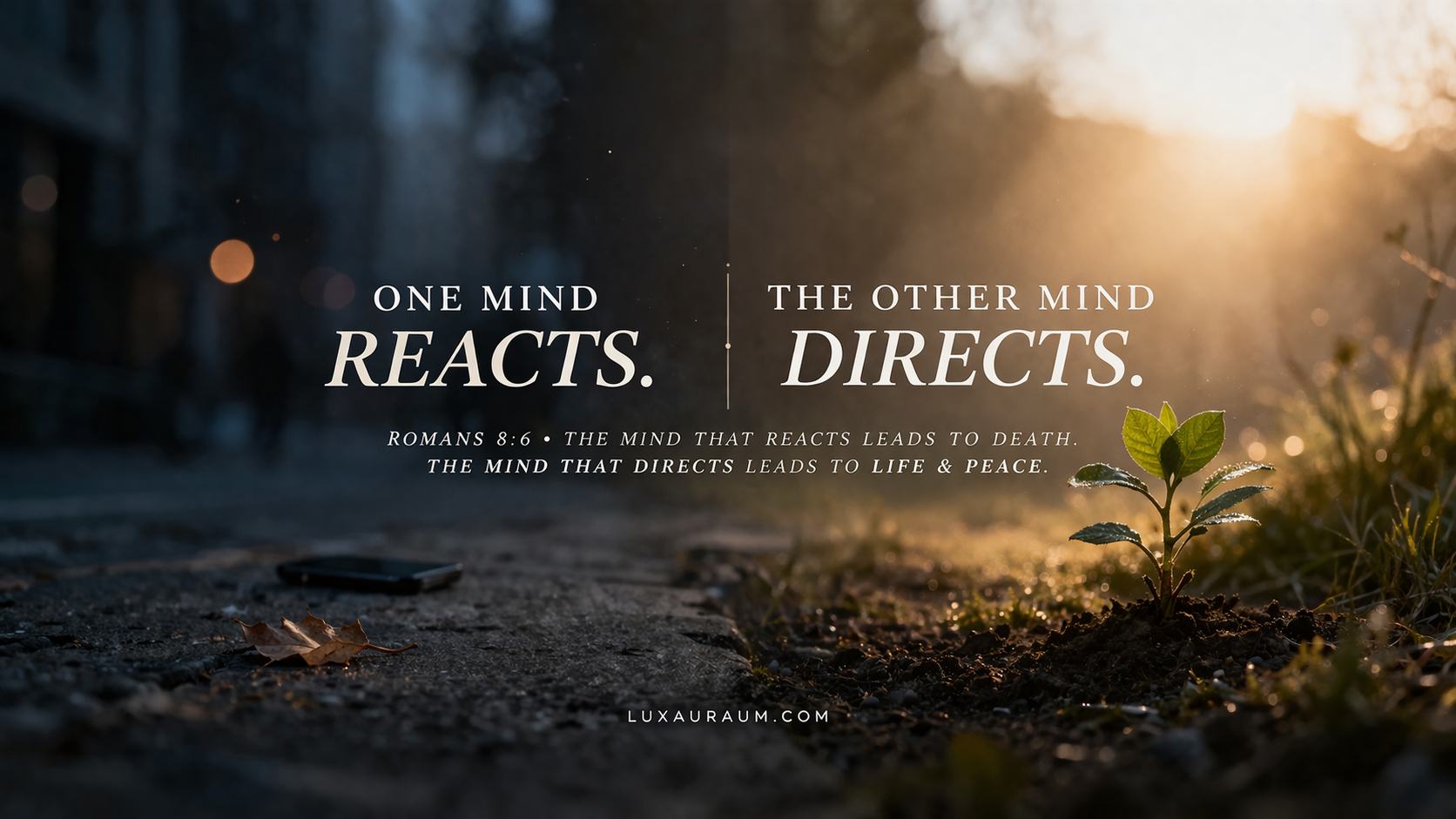
The carnal mind sees what is. The spiritual mind sees what could be. One reacts. The other directs. One leads to death. The other leads to life.
Every human being lives with two minds, one mind reacts to life, the other mind shapes life.
Most people never realize which one is running their future.The Bible calls this the difference between death and life. Neuroscience calls it automatic vs executive control. The question is not whether you have both, the question is: Which mind is in charge today?
People have long said "the spirit controls the physical." What many traditions were describing is that the unseen mind—consciousness itself—organizes action, and action shapes physical reality.
You look at people who succeed—in business, in health, in relationships—and you see the results. The money. The body. The happy family. You see what everyone sees.
But you do not see what they did that you cannot see. The early mornings. The decisions no one applauded. The mental work. The unseen disciplines. The inner orientation that made the outer results possible.
You wonder: What are they doing that I am not? What is the difference between those who thrive and those who merely survive?
Here is the truth that changes everything:
The difference is not in what they have. The difference is in how their mind operates. One mind reacts to the physical. The other mind directs the physical. The unseen mind organizes the physical world through perception, decision, and action.
The Apostle Paul wrote: "To be carnally minded is death, but to be spiritually minded is life and peace" (Romans 8:6).
The carnal mind is the mind set on the physical—what is visible, what is already present. It reacts. It worries. It is trapped by what it sees. This is the brain's default operating state. It is not evil. It is automatic.
The spiritual mind is the mind set on intention, values, and long-term vision. It directs. It creates. It acts from conscious choice, not impulse. This is the brain's executive state. It is not supernatural. It is intentional.
The unseen mind shapes physical results through behavior and perception. The carnal mind reacts. The spiritual mind directs.
WHAT THE BIBLE ACTUALLY SAYS
The Apostle Paul writes in Romans 8:5-8:
"Those who live according to the flesh have their minds set on what the flesh desires; but those who live in accordance with the Spirit have their minds set on what the Spirit desires. The mind governed by the flesh is death, but the mind governed by the Spirit is life and peace."
Paul is not condemning the physical world. He is describing two orientations of consciousness.
The carnal mind is the mind set on immediate perception—what is seen, what is felt, what is desired in the moment. It is automatic. It is reactive.
The spiritual mind is the mind set on intention, values, and long-term vision. It is directed. It is proactive.
2 Corinthians 4:18:
"So we fix our eyes not on what is seen, but on what is unseen, since what is seen is temporary, but what is unseen is eternal."
The unseen is not a mystical realm. The unseen includes intention, decision, belief, habit—the inner orientation that produces outer action.
Proverbs 23:7:
"For as he thinks in his heart, so is he."
The unseen thought becomes the seen person. The carnal mind thinks about what is. The spiritual mind thinks about what will be.
Deuteronomy 30:19:
"I have set before you life and death, blessings and curses. Now choose life."
The choice is not about believing the right doctrine. It is about choosing which orientation of mind will govern your actions.
WHAT THE TORAH TEACHES
The Torah opens with the creation of the physical world—but the unseen came first.
Genesis 1:3:
"And God said, 'Let there be light,' and there was light."
The word came first. The intention came first. The unseen preceded the seen. This is not about supernatural magic. It is about the principle that inner orientation precedes outward action.
Exodus 31:3 describes Bezalel, the craftsman of the Tabernacle:
"I have filled him with the Spirit of God, with wisdom, with understanding, with knowledge, and with all kinds of skills."
The skill is physical. The wisdom, understanding, and knowledge are unseen. The inner orientation came first. The skill followed.
Deuteronomy 8:18:
"Remember the Lord your God, for it is He who gives you the ability to produce wealth."
The ability to produce wealth is unseen—it is the capacity to work, to decide, to persist, to create. The carnal mind sees the wealth. The spiritual mind develops the unseen ability that produces it.
In biblical and Jewish thought, "spirit" often refers to the inner orientation of consciousness—intention, awareness, and will. The Hebrew word ruach means breath, life-force, inner disposition. The Greek word pneuma means animating principle, mindset, orientation.
The spiritual mind is a consciously directed mind aligned with meaning, values, and long-term vision.
WHAT THE KABBALAH TEACHES
Kabbalah describes reality symbolically as layers, teaching that inner intention precedes outward action. It is not making claims about physics. It is making claims about consciousness.
The Four Worlds (Olamot):

The physical world (Assiyah) is the last. Everything physical has a symbolic root in intention and will. The carnal mind sees only Assiyah. The spiritual mind works on intention, which shapes action.
The Baal Shem Tov taught that the yetzer hara (the carnal inclination) is not evil—it is the energy of the physical world. It is the brain's default mode. When it dominates without conscious direction, it blinds you to longer-term values. The goal is not to destroy it but to direct it.
The Zohar teaches that the physical world is the garment of the spiritual—not because spirits control matter, but because intention clothes itself in action.
WHAT THE ZOHAR TEACHES
Zohar (Beresheet 2:2) :
"The Holy One looked into the Torah and created the world."
The Torah—the spiritual blueprint—existed before the physical world. The unseen blueprint produced the seen creation. The carnal mind sees the world. The spiritual mind studies the blueprint of intention, values, and vision.
Zohar (Vayakhel 23:1) teaches:
"Everything that exists below has a root above."
Your physical actions have a root in your intentions. Your physical results have a root in your unseen decisions. The carnal mind works on the branch. The spiritual mind works on the root.
The Zohar is describing reality symbolically. It teaches that inner intention precedes outward action—a principle that is psychologically and philosophically sound, not a claim about supernatural causation.
A REAL-WORLD EXAMPLE — THE BUSINESS THAT SUCCEEDS
What the carnal mind sees:
- The money
- The building
- The employees
- The visible success
What the carnal mind thinks:
- "They are lucky."
- "I could never do that."
- The carnal mind is trapped by what it sees.
What the spiritual mind sees:
- The decisions made when no one was watching
- The discipline to work when motivation was absent
- The mental frameworks that guided choices
- The inner work that produced outer results
What the spiritual mind thinks:
- "What decisions did they make that I am not making?"
- "What disciplines do they practice that I am not practicing?"
- "What inner orientation produced these seen results?"
The spiritual mind does not envy the result. It studies the cause. It knows that the unseen mind organizes physical reality through perception, decision, and action.
THE SCIENCE — TWO MODES OF HUMAN CONSCIOUSNESS
Ancient scripture described two ways of living long before neuroscience existed. Modern brain research identifies two large-scale systems that mirror this insight.
The Default Mode Network — The Automatic Mind (The Carnal Mind)
The Default Mode Network (DMN) activates when the brain operates on autopilot: replaying memories, imagining scenarios, comparing oneself to others, and reacting emotionally to circumstances.
This state is natural and necessary for survival. It is not sinful or bad. It is simply the human default.
In biblical language, this resembles the mind "set on the flesh"—a mind governed primarily by immediate perception and impulse.
When the DMN dominates, you experience:
- Worry about what might happen
- Rumination about what already happened
- Comparison to others
- Emotional reaction to circumstances
- Comfort-seeking over value-seeking
The carnal mind is not immoral. It is automatic.
Paul's warning was not against having a body—but against being governed only by automatic impulses.
The Executive Control Network — The Directed Mind (The Spiritual Mind)
When a person intentionally focuses attention, sets goals, restrains impulses, or chooses meaning over comfort, another system becomes dominant: the Executive Control Network (ECN).
This network allows human beings to act according to values rather than reactions.
When the ECN is active, you experience:
- Goal-directed behavior
- Impulse regulation
- Long-term planning
- Choice based on values, not urges
- Conscious direction of attention
This is scientifically measurable. It represents conscious regulation over default reactions.
In biblical language, this parallels the mind "set on the Spirit"—not supernatural control, but intentional consciousness.
The Parallel
Scripture and neuroscience describe the same human reality using different languages:

One mind reacts. One mind directs. Life and peace emerge when conscious direction governs automatic impulse.
THE UNSEEN MIND SHAPES THE PHYSICAL
This is the core principle that holds together scripture, Kabbalah, and science.
The mind is unseen. Yet it produces measurable physical outcomes through:
- Decisions
- Habits
- Emotional regulation
- Attention control
- Persistence
Psychology calls this:
- Cognitive framing
- Executive regulation
- Neuroplastic adaptation
The correct statement is: The unseen mind shapes physical results through behavior and perception.
The carnal mind—the automatic, reactive mind—is dominated by immediate perception. It sees what is and reacts. It cannot create because it cannot see beyond what is already present.
The spiritual mind—the directed, intentional mind—is dominated by values, goals, and long-term vision. It sees what could be and acts. It creates because it acts on the unseen before the seen appears.
HOW TO CULTIVATE THE SPIRITUAL MIND
The carnal mind is the default. It requires no effort. The spiritual mind must be trained.
Practice 1: Notice Which Mode Is Active
Throughout the day, pause and ask: Is my mind in automatic mode or directed mode?
- Automatic mode: Worrying, planning, comparing, rehearsing, reacting
- Directed mode: Present, intentional, value-aligned, proactive
You cannot change what you do not notice.
Practice 2: Shift from Reaction to Intention
When you feel an impulse—to check your phone, to avoid a task, to react in anger—pause. Take one breath. Ask: What does my value system say I should do here?
The pause is the executive network engaging. It is the spiritual mind taking over from the automatic mind.
Practice 3: Work on the Unseen Cause
When you see a result—good or bad—ask: What unseen decisions, disciplines, or mindsets produced this?
Do not stop at the physical. Go deeper to the intention and action that produced it.
Practice 4: Direct Your Attention Intentionally
The automatic mind follows whatever stimulus is loudest. The directed mind chooses what to focus on.
Set aside time each day to focus intentionally—on a task, on a prayer, on your breath, on a goal. This is training the executive network.
Practice 5: Act on What Is Not Yet Seen
The automatic mind waits to see results before it acts. The directed mind acts on what it knows will come.
Plant the seed before you see the tree. Write the book before you have readers. Start the business before you have customers. The unseen action produces the seen result.
The carnal mind sees the physical—what is already there. It reacts. It is trapped by circumstances. It is the brain's default mode. It is not evil. It is automatic.
The spiritual mind sees the unseen—the decisions, the disciplines, the intentions that shape the physical. It directs. It creates. It is the brain's executive mode. It is intentional.
Ancient spiritual writers described what neuroscience now observes: human beings possess both an automatic mind and a directed mind.
The carnal mind is not sin. It is default. The spiritual mind is not supernatural. It is intentional.
Life and peace emerge when conscious direction governs automatic impulse. Death emerges when automatic impulse governs everything.
The choice is not between good and evil. The choice is between reaction and intention.
Sources cited:
- Romans 8:5-8
- 2 Corinthians 4:18
- Proverbs 23:7
- Deuteronomy 30:19
- Genesis 1:3
- Exodus 31:3
- Deuteronomy 8:18
- Zohar (Beresheet 2:2, Vayakhel 23:1)
- Baal Shem Tov teachings
- Neuroscience of Default Mode Network (DMN) and Executive Control Network (ECN)





Collective Insights
Be the First to Share
Your insights could spark meaningful conversations. Share your thoughts above!
Share Your Insight