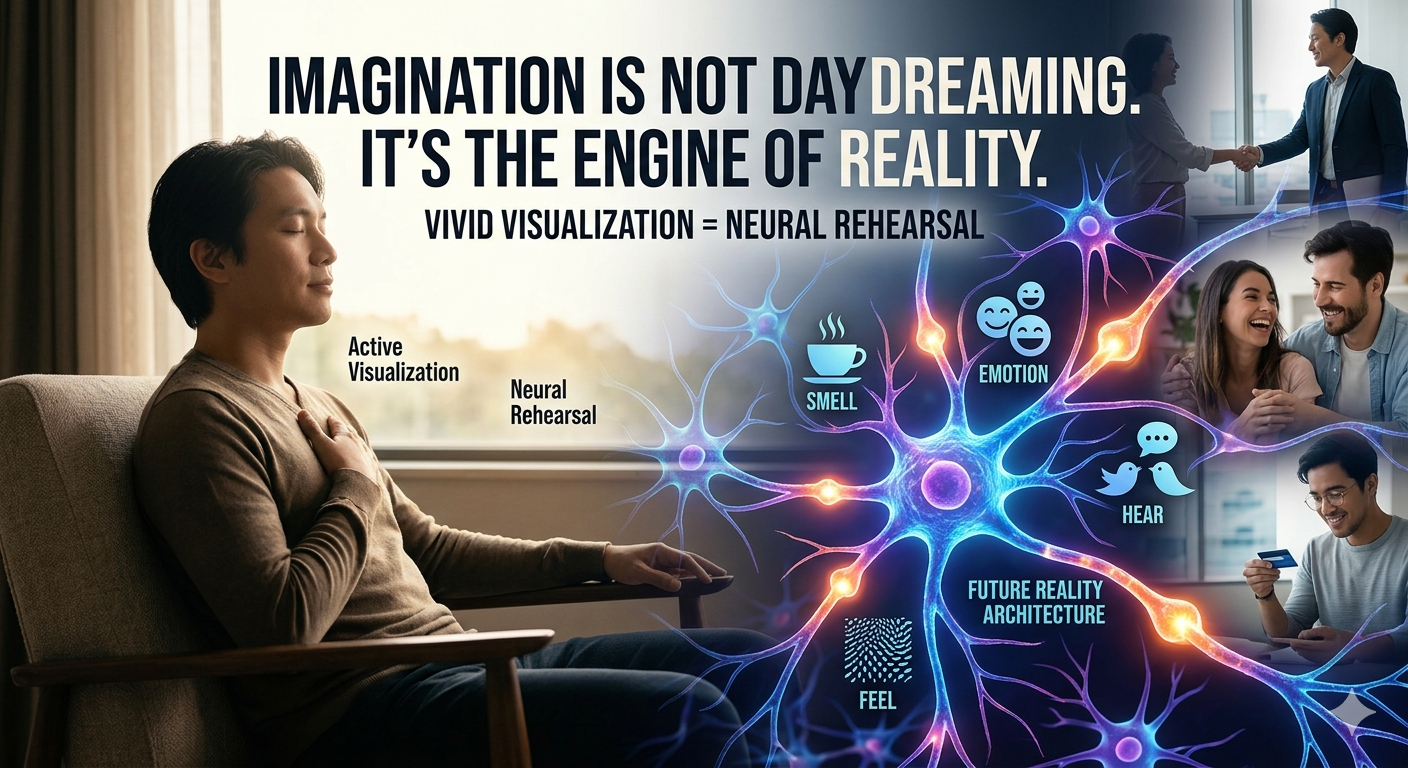
When you imagine something vividly, your brain does not know the difference between what you are seeing in your mind and what you are seeing with your eyes.
The same neural circuits fire. The same chemicals release. The same pathways strengthen.
You are not "just imagining." You are rehearsing reality.
You have tried to manifest. You have visualized. You have sat with your eyes closed, trying to see your dream life. But it felt like pretending. It felt like lying to yourself. The images were flat, distant, unconvincing. Nothing changed.
You wonder: Am I doing it wrong? Does imagination even work? Or is this just wishful thinking dressed in spiritual clothing?
Here is the truth that changes everything:
Imagination is not "seeing what you want." Imagination is rehearsing the experience of already having it. And your brain treats rehearsal as preparation for reality.
The ancient sages taught that imagination is the creative force of the universe. Modern neuroscience has proven they were right—not about the metaphysics, but about the mechanism.
Your brain has something called the default mode network (DMN) and the executive control network (ECN) . When you vividly imagine a future scenario with emotion and sensory detail, you are literally rewiring your brain to recognize, pursue, and create that scenario in waking life.
Imagination is not escape. Imagination is practice. And practice changes what you become.
PART ONE: WHAT ACTUALLY HAPPENS IN YOUR BRAIN WHEN YOU IMAGINE
The Science (Explained Simply)
When you imagine doing something—scoring a goal, giving a speech, having a difficult conversation—the same brain regions activate as when you actually do it.
[Neuroscience note: This is why athletes visualize. This is why actors method act. This is why trauma victims relive. The brain does not distinguish between "real" and "vividly imagined" when it comes to neural activation.]
What This Means For Manifestation
When you imagine your desired outcome with:
- Clarity (specific details, not vague wishes)
- Sensory richness (what do you see, hear, feel, smell, taste?)
- Emotion (the feeling of already having it)
- Repetition (daily practice, not once a month)
Your brain begins to treat that outcome as a memory of something that has already happened.
And a brain that believes something has already happened will:
- Notice opportunities to make it happen again
- Filter perception toward evidence that supports it
- Motivate behavior aligned with it
- Reduce anxiety and resistance around it
This is not magic. This is predictive processing.
PART TWO: WHY MOST IMAGINATION PRACTICES FAIL
Mistake 1: Vague Visualization
Bad: "I imagine myself happy and wealthy."
Why it fails: Your brain cannot work with "happy and wealthy." Those are abstractions. Your brain needs specific sensory data.
Good: "I imagine myself waking up in my new apartment. I see the morning light through the window. I feel the soft sheets. I hear birds outside. I smell coffee brewing. I feel the satisfaction of knowing I am home."
Mistake 2: No Emotional Charge
Bad: Flat, mechanical visualization (like reading a grocery list)
Why it fails: Emotion is the glue that tags memories as important. Without emotion, your brain treats the visualization as irrelevant.
Good: Generate the feeling of already having it. Gratitude. Relief. Joy. Pride. Satisfaction. Let the emotion rise in your body.
Mistake 3: Once and Done
Bad: Visualize once, hope for the best, never return.
Why it fails: One repetition strengthens a neural pathway minimally. The old pathway (the one that expects struggle) is still the superhighway.
Good: Daily practice. 5-10 minutes. Same scene. Same emotion. Same sensory details. Repetition builds the new pathway.
Mistake 4: No Action Bridge
Bad: Visualize and wait.
Why it fails: Imagination programs the brain to recognize opportunities. But you still have to act when opportunities appear.
Good: After each visualization session, ask: "What is one small action I can take today that my future self would take?" Then take it.
PART THREE: THE 4-STEP IMAGINATION PROTOCOL (For Real Results)
Step 1: The Sensory Anchor
Before you visualize, engage a physical sense to anchor your brain in the "as if" state.
Option A: Hold an object that represents your goal (a key for a new home, a pen for a book, a coin for wealth)
Option B: Place your hand on your heart. Feel your heartbeat. This activates presence.
Option C: Take three slow breaths (4 in, 6 out). This calms the nervous system and opens receptivity.
Step 2: The Scene Construction (5 minutes)
Close your eyes. Build your scene from the ground up:
Step 3: The Emotional Peak (2 minutes)
Once the scene is built, let the emotion rise. Do not force it. Allow it. Let the feeling of already having your desire spread through your body.
Ask yourself: "If this were real right now, how would my body feel? What would be the dominant emotion?"
Then stay there. Breathe into that feeling. Let it expand.
[Neuroscience note: Emotion activates the amygdala, which tags the experience as "important." The hippocampus then prioritizes this memory for long-term storage. Without emotion, the visualization is just a thought.]
Step 4: The Action Bridge (1 minute)
After opening your eyes, immediately ask:
"What is one small action I can take today that the person who already has this would take?"
Then write it down. Then do it within 24 hours.
The action does not need to be large. It needs to be real. A single email. A single dollar saved. A single conversation. One small step that proves to your brain: "This is not just imagination. This is preparation."
PART FOUR: THE THREE LEVELS OF IMAGINATION
Level 1: Passive Daydreaming (What Most People Do)
- Eyes open, distracted
- No sensory detail
- No emotion
- No repetition
- No action
Result: Nothing changes. The brain treats it as entertainment, not preparation.
Level 2: Active Visualization (What People Try)
- Eyes closed, focused
- Some sensory detail
- Some emotion
- Inconsistent repetition
- Occasional action
Result: Some change, but slow and unreliable.
Level 3: Neural Rehearsal (What Works)
- Eyes closed, fully present
- Rich sensory detail (all five senses)
- Strong, embodied emotion
- Daily repetition (5-10 minutes)
- Immediate aligned action
Result: The brain treats the imagined scenario as a memory. Perception shifts. Behavior shifts. Results follow.
PART FIVE: PRACTICAL EXAMPLES
For a Job You Want
Scene: You are sitting at your new desk. You see your nameplate. You hear the office sounds. You feel the satisfaction of knowing you belong there. You feel relief that the search is over.
Emotion: Gratitude, relief, competence.
Aligned Action: Update one section of your resume. Send one application. Message one connection.
For a Relationship
Scene: You are sitting across from your partner at a café. You hear their laugh. You feel the warmth of their hand. You smell the coffee. You feel the ease of being with them.
Emotion: Love, safety, joy.
Aligned Action: Go somewhere new. Strike up one conversation. Open one dating app and swipe intentionally. Or, if in a relationship already, initiate one genuine moment of connection.
For Financial Freedom
Scene: You check your bank account. You see the number. You feel the peace of knowing you are safe. You see your investments growing. You feel the freedom to choose how to spend your time.
Emotion: Peace, safety, freedom.
Aligned Action: Save $5. Research one investment. Cancel one unnecessary subscription. Create one stream of income.
For Healing
Scene: You wake up in the morning and realize you slept through the night. You feel energy in your body. You move without pain. You feel the vitality returning.
Emotion: Relief, hope, strength.
Aligned Action: Drink water. Take one supplement. Walk for 5 minutes. Rest without guilt. Make one doctor's appointment.
PART SIX: THE DANGER OF IMAGINATION WITHOUT ACTION
Imagination alone is not enough. It never has been.
The law of reverse effect: When you visualize vividly but take no action, you can actually increase your frustration and despair. Your brain begins to believe the outcome is possible, but reality keeps disproving it. The gap between the imagined and the actual creates suffering.
The fix: Action. Even tiny action. The smallest proof that you are moving toward the imagined reality. This tells your brain: "This is real. This is happening. Keep going."
PART SEVEN: HOW TO KNOW IT'S WORKING
The loop completes.
Imagination is not daydreaming. It is neural rehearsal.
When you imagine with clarity, sensory detail, emotion, repetition, and aligned action, you are not pretending. You are training your brain for a reality that does not yet exist.
The brain does not know the difference between a vivid memory and a vivid visualization. It treats both as experience. Experience changes the brain. A changed brain changes perception. Changed perception changes action. Changed action changes outcomes.
You are not "just imagining." You are constructing the neural architecture of your future self.
The question is not whether imagination works. It does.
The question is: are you using it—or is it using you?
What will you rehearse today?








Collective Insights
Be the First to Share
Your insights could spark meaningful conversations. Share your thoughts above!
Share Your Insight