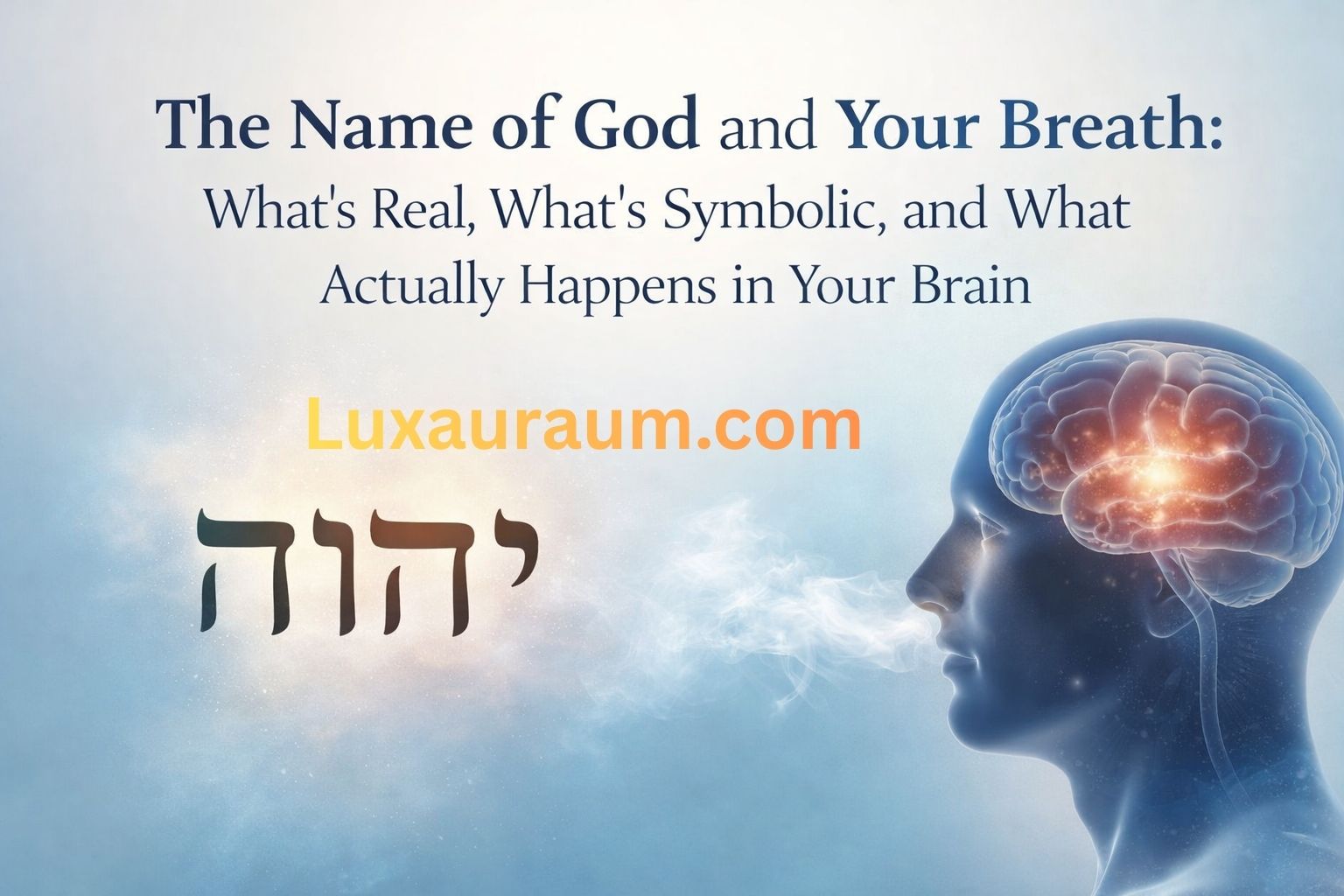
You've heard it said: "Every time you breathe, you're speaking the name of God." It's beautiful. It's poetic. But is it true? The answer is more interesting than yes or no.
You've seen the posts. The reels. The spiritual influencers telling you that the Hebrew name of God—YHWH—is literally the sound of breathing. Inhale = "Yah." Exhale = "Weh." Every breath a prayer. Every lungful a divine name.
It feels profound. It makes you look at your own breathing differently.
But somewhere, a question nags: Is this real? Did ancient Hebrew really work like that? Or is this something someone made up to sell courses?
You want to know the truth. Not because you're skeptical of spirituality—but because you want your spirituality grounded in something real.
Here's the honest answer:
The breath-name connection is not historically accurate. But it points to something that is: breath has always been the symbol of life, spirit, and the divine in human consciousness. And modern neuroscience shows that controlling your breath genuinely changes your brain in ways that feel spiritual.
Let's walk through this clearly. No mysticism. No dismissal. Just the historical truth about the name, the symbolic truth about breath, and the scientific truth about what happens in your brain when you breathe with intention.
PART ONE: WHAT THE NAME ACTUALLY IS—HISTORICAL TRUTH
The Hebrew name of God is written as יהוה (often rendered YHWH in English). It's called the Tetragrammaton—Greek for "four letters."
It appears thousands of times in the Hebrew scriptures.
Here's what scholars actually know:

What the "breath theory" claims: That YHWH is pronounced "Yah-Weh," and that these sounds mimic the natural sound of inhaling and exhaling.
The historical truth: Ancient Hebrew texts never describe the name this way. There is no record in Jewish tradition—rabbinic, mystical, or otherwise—that interprets the Tetragrammaton as the sound of breathing. The interpretation is modern spiritual symbolism, not ancient teaching.
PART TWO: WHERE THE BREATH CONNECTION ACTUALLY COMES FROM
The reason this idea resonates is because the Bible does connect breath, spirit, and life—just not through the pronunciation of the name.
The Hebrew word רוּחַ (Ruach) means three things:
· Breath
· Wind
· Spirit
These were understood as the same fundamental force: the invisible movement of life.
Key biblical example:
In Genesis, God forms Adam from dust and then breathes into his nostrils. That breath makes Adam a "living being." The breath of God becomes the life of man.
So the symbolic connection is real: breath = life = spirit = divine presence.
But this is different from saying every breath literally pronounces the divine name.
PART THREE: WHY THE NAME WAS TREATED DIFFERENTLY
Ancient Jewish tradition eventually considered the name too sacred to speak aloud.
Instead, they used substitute words:

This tradition developed after the Babylonian exile (6th century BCE). By the time of Jesus, the original pronunciation was likely already lost among the general population. Only the High Priest in the Temple may have spoken it—once a year, on Yom Kippur.
After the Temple was destroyed in 70 CE, even that stopped. The pronunciation faded completely.
[Historical note: This is why we don't know exactly how YHWH was said. It's not a conspiracy—it's a 2,000-year gap in oral tradition.]
PART FOUR: WHAT NEUROSCIENCE ACTUALLY SAYS ABOUT BREATH
Even though the "name-of-God-as-breath" idea is symbolic rather than historical, breathing is genuinely one of the most powerful tools for influencing your brain and body.
Here's what happens when you breathe:
Your breathing directly influences your vagus nerve—the longest nerve in your autonomic nervous system. It runs from your brainstem down to your abdomen, connecting to your heart, lungs, and digestive organs.


· Calmer
· More focused
· Less reactive
· More present
This is not spiritual belief. This is measurable brain science.
PART FIVE: WHY EVERY SPIRITUAL TRADITION USES BREATH
Across religions and spiritual practices, breath is central:

Why? Because every tradition discovered the same thing through observation: breath regulates consciousness.
They didn't have fMRI machines. They had millennia of practitioners reporting: "When I breathe this way, I feel closer to the divine."
They explained it using their language—spirit, energy, God. We now have additional language—neuroscience, vagus nerve, prefrontal cortex.
Both are describing the same experience. Just different words.
PART SIX: WHAT "GOD WITHIN US" ACTUALLY MEANS
When religious traditions say "God is within you," they are speaking philosophically and spiritually, not anatomically.
It means:
· Human consciousness reflects divine intelligence
· Moral awareness exists inside each person
· Spiritual experience happens internally, not just in external rituals
· The divine can be encountered through inner reflection
This does not disprove faith. It simply explains how the experience happens in the body.
PART SEVEN: A GROUNDED PRACTICE—HONORING BOTH FAITH AND SCIENCE
If your goal is to feel closer to what you understand as divine, here's a practice that aligns with both spiritual tradition and neuroscience.
Step 1: Slow Your Breath
Sit comfortably. Breathe in through your nose for 4 seconds. Breathe out through your nose or mouth for 6 seconds. Repeat for 5-10 minutes.
Why: This pattern activates your vagus nerve and shifts your brain toward calm, focused presence.
Step 2: Focus Your Mind
While breathing, focus on:
· A meaningful phrase from your tradition
· A word like "peace," "love," or "presence"
· Gratitude for something specific
· The simple sensation of breathing
Why: Focused attention engages your prefrontal cortex and quiets mental chatter.
Step 3: Reflect on Meaning
After your breathing practice, spend a few minutes in quiet reflection. Ask:
· What feels different in my body?
· What thoughts or feelings arose?
· Is there anything I want to carry into my day?
Why: Reflection strengthens the neural pathways that integrate spiritual experiences into daily life.
Step 4: Align Your Actions
Every spiritual tradition emphasizes behavior:
· Honesty
· Compassion
· Discipline
· Humility
· Service
THE CLEAR TRUTH—FOR LAY PEOPLE TO UNDERSTAND:
Let me put this in the simplest terms possible:

The idea that every breath speaks God's name is beautiful. It's poetic. It makes you pay attention to something you do 20,000 times a day without thinking.
But it's not historically accurate. The ancient Hebrews never said this. The name YHWH was treated with too much reverence to be reduced to the sound of inhaling and exhaling.
Here's what is true:
Breath has always been the symbol of life and spirit. The Bible uses "breath" and "spirit" as the same word. When you breathe with intention, you activate brain states that people across every culture and every millennium have described as spiritual.
You don't need to believe in hidden mystical sounds to experience this. You just need to breathe—slowly, intentionally, with focus.
The divine, however you understand it, doesn't need your breath to be a secret code. Your breath is already sacred—because it keeps you alive, because it connects you to the present moment, because it's the most basic rhythm of existence.
Whether you call that God, consciousness, or biology, it's real. And it's yours.
What will you notice in your next breath?








Collective Insights
Be the First to Share
Your insights could spark meaningful conversations. Share your thoughts above!
Share Your Insight