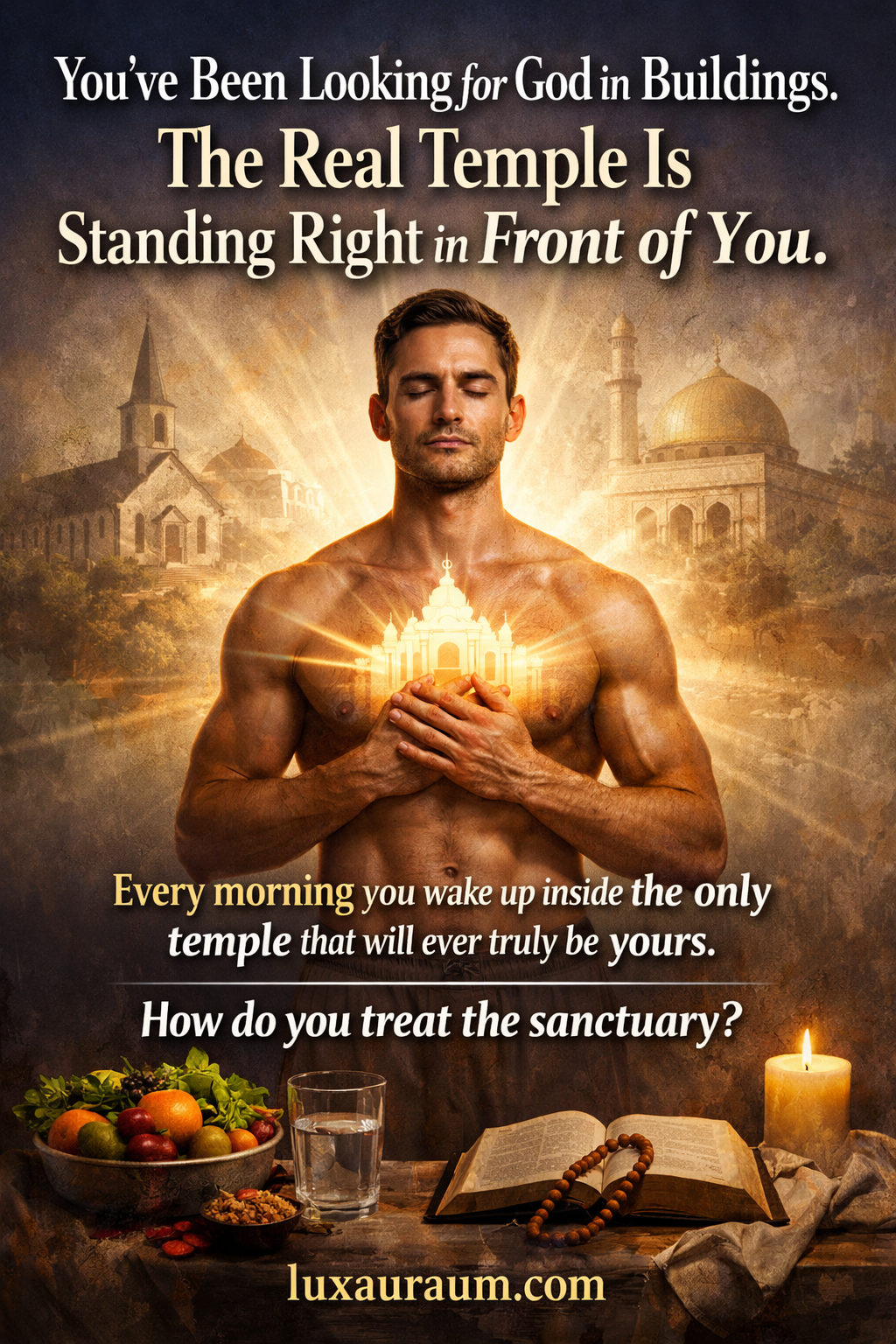
Every morning you wake up inside the only temple that will ever truly be yours. The question is: how do you treat the sanctuary?
You've been to churches, mosques, synagogues, temples. You've felt something in those spaces—the hush, the reverence, the sense that you're standing on holy ground.
But when you leave, you enter your body. And somehow, that feels ordinary. Mundane. Not holy at all.
You eat whatever is convenient. You push through exhaustion. You ignore pain. You feed yourself things you wouldn't offer to a guest.
And somewhere underneath, you suspect something is wrong.
If God dwells within you, why do you treat your body like a rental car instead of a sanctuary?
Every major spiritual tradition teaches that the body is not just a container—it's a temple. What you put into it, what you do with it, how you care for it—these are not secular concerns. They are acts of worship.
The physical and the spiritual are not separate. They never were.
WHAT THE SCRIPTURES ACTUALLY SAY ABOUT THE BODY
The idea that the body is a temple is not metaphor—it's a direct teaching across multiple traditions.
In Christianity:
1 Corinthians 6:19-20 (Apostle Paul):
"Do you not know that your bodies are temples of the Holy Spirit, who is in you, whom you have received from God? You are not your own; you were bought at a price. Therefore honor God with your bodies."
Paul wasn't speaking poetically. He was making a radical statement: the divine doesn't just dwell in buildings made by human hands. It dwells in you.
In Judaism:
The Talmud (Berachot 60b) teaches that upon waking, a person should thank God for restoring their soul to their body—recognizing that each day, the body is a gift returned to you.
Maimonides (Rambam) in his Mishneh Torah (Hilchot Deot 4:1) writes:
"Since maintaining a healthy and sound body is among the ways of God—for one cannot understand or have any knowledge of the Creator when ill—therefore, a person must distance himself from things that harm the body and accustom himself to things that heal and strengthen it."
The body is not separate from spiritual life. It is the instrument through which spiritual life is lived.
In Islam:
The Qur'an (2:195) commands:
"And do not throw yourselves into destruction with your own hands."
This verse is traditionally understood as prohibiting self-harm, including through neglect of the body's needs.
In Hinduism:
The Upanishads teach that the body is a temple where the divine resides. The physical form is not to be despised but honored as the dwelling place of consciousness.
THE KABBALISTIC VIEW—THE BODY AS SANCTUARY
Kabbalah takes this even deeper. The Zohar teaches that the human body mirrors the structure of the heavenly sanctuary.
Body Part
Spiritual Correspondence
Head
Keter (Crown) — connection to the divine
Brain
Chokhmah and Binah — wisdom and understanding
Heart
Tiferet — beauty, harmony, the center
Limbs
The other Sefirot — divine attributes manifest in action
Breath
Ruach — spirit, wind, life itself
The Zohar states:
"The upper and lower worlds are balanced against each other. The form of the human body contains everything that exists in the upper and lower worlds."
This means: when you care for your body, you are literally maintaining the balance of creation.
Rabbi Menachem Nachum of Chernobyl (1730-1797) taught that every organ and limb corresponds to a spiritual quality. When you honor your body through proper eating, rest, and care, you elevate those qualities.
THE TEMPLE AND WHAT ENTERS IT
If the body is a temple, then what you allow into it matters.
Food as Sacrifice
In ancient temples, offerings were brought—grain, wine, oil, animals. These were not just "food"—they were sacred substances, consecrated to the divine.
The Baal Shem Tov (founder of Chassidism) taught that when you eat with intention, you elevate the divine sparks hidden in food. Every meal becomes an act of worship.
"When you eat, you are not just feeding yourself. You are freeing holy sparks trapped in the physical world."
This is the opposite of mindless eating. It's sacred consumption.
What the Sages Taught About Balance
Maimonides devoted an entire section of his Mishneh Torah (Hilchot Deot) to proper eating habits:
"A person should never eat unless he is hungry, nor drink unless he is thirsty... One should not eat to the point of a full stomach, but approximately a quarter less than fullness."
The Talmud (Berachot 57b) teaches that a healthy stomach is a sign of divine favor:
"Three things restore a person's spirits: a beautiful home, a beautiful wife, and beautiful utensils."
But Ecclesiastes Rabbah 1:34 warns:
"Who is rich? One who is happy with their portion."
Balance is the key—not excess, not deprivation, but conscious moderation.
THE SCIENCE OF THE TEMPLE—WHAT WE NOW KNOW
Ancient traditions taught the body as temple based on revelation and observation. Modern science confirms the practical wisdom.
The Enteric Nervous System: The Second Brain
Your gut contains 100 million neurons—more than your spinal cord. It produces:
· 95% of your body's serotonin (mood regulation)
· 50% of your dopamine (motivation, reward)
The Vagus Nerve: The Mind-Body Highway
The vagus nerve connects your brain to your heart, lungs, and digestive organs. It's the physical infrastructure of the mind-body connection that mystics have described for millennia.
Inflammation and Consciousness
Chronic inflammation from poor diet doesn't just affect your body—it affects your brain:
· Depression is now understood as partly inflammatory
· Anxiety correlates with gut health
· Mental clarity depends on stable blood sugar
You cannot think clearly about God if your brain is inflamed by what you ate.
THE WARNING—WHEN THE TEMPLE IS DESECRATED
The prophets of Israel were not shy about condemning those who desecrated the Temple. What might they say about how we treat our bodies?
Jeremiah 7:11 accused the people of making the Temple "a den of robbers." How do we make our bodies a den of robbers?
· By filling them with substances that steal our clarity
· By depriving them of rest that restores our strength
· By using them in ways that dishonor their sacred purpose
The Talmud (Shabbat 33a) tells the story of Rabbi Shimon bar Yochai and his son, who hid in a cave for 12 years to escape Roman persecution. They survived on carobs and water. When they emerged, they saw people plowing and planting—engaged in worldly pursuits—and they were disturbed. A heavenly voice told them: "Have you emerged to destroy My world? Return to your cave."
The lesson: The spiritual life is not about escaping the physical. It's about sanctifying it.
THE KABBALISTIC PRACTICE—EATING WITH INTENTION
The Baal Shem Tov taught that there are divine sparks hidden in all physical things, especially food. The act of eating, done with intention, releases these sparks and elevates them.
A practice from Chassidic tradition:
Before eating, pause and consider:
1. Where did this food come from?
2. What energy went into producing it?
3. What divine spark might be hidden here?
During eating:
1. Eat slowly, with awareness
2. Chew thoroughly—this is itself an act of refinement
3. Notice the flavors, textures, sensations—these are gifts
After eating:
1. Offer gratitude
2. Notice how the food affects your body
3. Dedicate the energy you've received to some good purpose
BALANCE—THE TRUE PATH OF THE TEMPLE
Every spiritual tradition warns against two extremes:
Extreme 1: Neglect
Some spiritual seekers think the body doesn't matter. They neglect it, abuse it, treat it as a prison to escape.
The Torah rejects this. The body was created by God and called "very good" (Genesis 1:31). To neglect it is to dishonor the Creator.
Extreme 2: Worship
Others make the body an idol. They obsess over appearance, pleasure, sensation—treating physical experience as the ultimate goal.
The Torah also rejects this. The body is a temple, not a god. It houses the divine; it is not divine itself.
The Middle Path: Stewardship
Maimonides taught that the proper approach is balance:
"One should direct his heart and all his actions toward one goal: knowing God... Even eating, drinking, sleeping, and marital relations should be done with the intention of maintaining health and strength for the service of God."
This is stewardship—caring for the temple so that the One who dwells within can be honored.
WHAT BALANCE LOOKS LIKE IN PRACTICE
Nutrition
The Talmud (Berachot 57b) teaches: "A person should always eat less than his means allow, dress according to his means, and honor his wife and children beyond his means."
Applied to eating:
· Eat what nourishes, not just what pleases
· Stop before full
· Let food be medicine before it becomes poison
Rest
Exodus 20:8 commands: "Remember the Sabbath day, to keep it holy."
The Sabbath is not just a spiritual practice—it's a physical one. One day of rest restores the body, calms the nervous system, and reminds you that you are a human being, not a human doing.
Movement
Maimonides (Hilchot Deot 4:14) prescribes:
"One should exercise and exert himself greatly every day... for physical activity warms the body and prevents the accumulation of harmful substances."
Movement is not optional. It's maintenance of the temple.
The temple is not a building in Jerusalem, not a church on the corner, not a mosque with a minaret.
The temple is you.
Every breath you take is incense rising. Every meal you eat is an offering. Every moment of rest is a Sabbath. Every movement is a prayer.
The question is not whether you will worship. You are worshiping every moment—with what you put in your body, with how you treat yourself, with whether you honor the sanctuary you've been given.
The only question is: what kind of worship will it be?
The Baal Shem Tov taught: "God dwells wherever you let God in."
Your body is where the divine has chosen to dwell. Not in spite of being physical—but through being physical.
This post does in no way say you stop visiting your various places of worship because communion is just as important to help uplift eachother and help uplift our souls. It is also important for various reasons but we must be clear that your body is the true temple and not the building.
Honor the temple. It's the only one you'll ever have.
What will you offer your temple today?



Collective Insights
Be the First to Share
Your insights could spark meaningful conversations. Share your thoughts above!
Share Your Insight