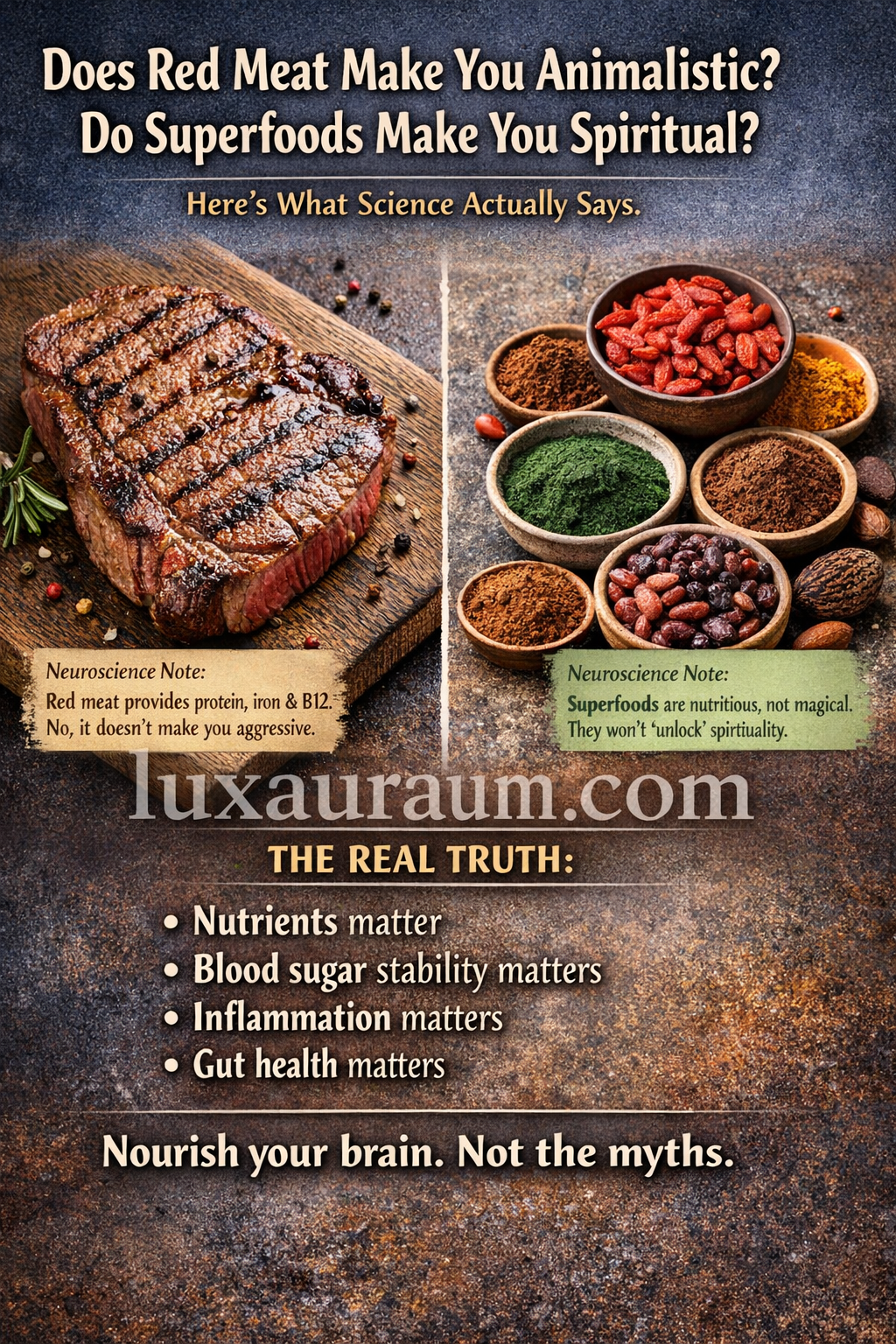
You've been told that red meat makes you aggressive. That certain "superfoods" unlock spiritual powers. That what you eat determines how enlightened you can become.
Some of this is true. Some of it is superstition dressed in health-food packaging. And the difference matters—because your beliefs about food affect you as much as the food itself.
You've been on the spiritual path long enough to hear the food rules. No meat—it clouds your energy. Only raw—cooked food is dead. Eat these superfoods for higher consciousness. Avoid those foods for purity.
You've tried to follow the rules. Maybe you felt better. Maybe you felt hungry, anxious, or simply confused. You've spent money on "spiritual" foods that promised enlightenment but delivered only lighter wallet.
You wonder: Is any of this real? What actually affects my consciousness? And what is just another way to make me feel like I'm not doing enough?
Here's the truth that changes everything:
Food absolutely affects your brain. And your brain is the instrument of your consciousness. But the most dramatic spiritual food claims are often placebo, not physiology. And the foods that actually matter are not the expensive "superfoods"—they are the nutrients your brain needs to function.

Food affects your consciousness through blood sugar stability, neurotransmitter availability, inflammation, and gut-brain signaling. These effects are real, measurable, and powerful.
But the claims that specific foods "make you spiritual" or "make you animalistic" are largely cultural stories, not biological facts. What is real: deficiencies impair consciousness. Adequate nutrition supports it. And the most important "spiritual food" is the one that keeps your brain nourished, stable, and clear.
THE FOOD CLAIMS—DEBUNKED, EXPLAINED, AND SUPPORTED
Claim 1: Red Meat Makes You Aggressive, Animalistic, or Hyper-Passionate
The Claim: Eating red meat increases aggression, sexual passion, and "base" instincts. Some spiritual traditions teach that meat-eaters are more animalistic; vegetarians are more refined.
The Origin: This belief comes from:
- Ancient philosophical traditions (Pythagorean, some Greek schools)
- Religious asceticism (certain Hindu, Buddhist, and Christian sects)
- Colonial narratives linking meat-eating to "primitiveness"
- Modern animal rights rhetoric
What Science Says:
There is no credible evidence that red meat causes aggression or "animalistic" behavior.
What the research does show:

[Neuroscience note: If any food causes aggression, it's more likely to be sugar crashes, caffeine overstimulation, or alcohol—not protein. The belief that meat causes aggression is a cultural story, not a biological fact. What is real: hunger (low blood sugar) causes irritability. Protein prevents that.]
The Placebo Effect: If you believe red meat makes you aggressive, you may:
- Eat it with guilt (stress response)
- Interpret normal frustration as "aggression"
- Notice behaviors that confirm your belief
- Ignore evidence to the contrary
Conclusion: Red meat does not cause aggression. It provides protein, iron, B12, and zinc—all essential for stable mood and clear thinking. Deficiencies in these nutrients are far more likely to cause irritability than the meat itself.
Claim 2: Certain "Superfoods" Unlock Spiritual Powers
The Claim: Goji berries, spirulina, cacao, maca, and other "superfoods" elevate consciousness, open the third eye, or unlock spiritual abilities.
The Origin: Marketing, wellness industry, and genuine traditional knowledge about medicinal plants.
What Science Says:
No food "unlocks" spiritual powers. But nutrients absolutely affect brain function.

[Neuroscience note: These foods are nutrient-dense. They provide the building blocks your brain needs to function optimally. But they do not "unlock" anything that wasn't already there. Think of them as premium fuel—not magic.]
The Reality: If you are deficient in essential nutrients, correcting that deficiency can dramatically improve brain function. This can feel "spiritual" because your clarity, mood, and energy improve. But the effect is nutrition, not magic.
Claim 3: Sugar and Processed Foods "Block" Spirituality
The Claim: Sugar and processed foods lower your vibration, block intuition, and prevent spiritual growth.
The Origin: Ayurveda, traditional medicine, and modern wellness culture.
What Science Says:
This is largely supported—with nuance.

[Neuroscience note: Chronic high sugar intake affects the brain's reward system, making it harder to experience pleasure from non-sugar sources. It also promotes inflammation, which is linked to depression and cognitive decline. These effects can make spiritual practice—which requires attention, clarity, and stable mood—significantly harder.]
Conclusion: Sugar and processed foods do not "block" spirituality. But they make it harder to be clear, calm, and present. That is real.
Claim 4: Fasting Purifies the Mind and Opens Spiritual Awareness
The Claim: Fasting clears mental fog, heightens intuition, and brings you closer to the divine.
The Origin: Every major spiritual tradition—Judaism, Christianity, Islam, Buddhism, Hinduism—includes fasting practices.
What Science Says:
Supported—with important caveats.

[Neuroscience note: Short-term fasting (12-24 hours) can increase BDNF and reduce inflammation. Some people experience heightened clarity. But prolonged fasting can cause nutrient deficiencies, blood sugar crashes, and cognitive impairment. The spiritual traditions that include fasting almost always pair it with prayer, meditation, and community—not just starvation.]
The Danger: When fasting becomes obsessive, guilt-based, or a measure of spiritual worth, it becomes harmful—not helpful.
Claim 5: Eating Animals "Absorbs" Their Energy
The Claim: Eating meat transfers the animal's consciousness, fear, or karma to the eater.
The Origin: Some Hindu, Buddhist, and New Age teachings.
What Science Says:
No evidence for energy transfer. But ethical and psychological factors are real.
- No measurable "energy" transfers from animal to eater
- However, if you believe it does, you may experience psychological effects (placebo/nocebo)
- Ethical considerations about how animals are raised and slaughtered are legitimate—but separate from biological effects
[Neuroscience note: If eating meat causes you stress, guilt, or moral conflict, that stress affects your brain. The amygdala activates, cortisol rises, and your nervous system shifts toward threat. This can feel like "heavy energy"—but it's your own stress, not the animal's.]
Conclusion: The effect of meat on consciousness is primarily psychological and nutritional, not metaphysical.
WHAT ACTUALLY AFFECTS YOUR BRAIN—THE REAL MECHANISMS
1. Blood Sugar Stability
Your brain runs on glucose. When blood sugar crashes, your prefrontal cortex (executive function) suffers.
What helps:
- Protein with meals
- Complex carbohydrates (not simple sugars)
- Eating regularly (not skipping meals)
- Avoiding sugar spikes and crashes
2. Neurotransmitter Availability
Your brain produces mood-regulating chemicals from food.

[Neuroscience note: Without adequate building blocks, your brain cannot produce these chemicals. This doesn't mean you need "superfoods"—it means you need adequate protein, healthy fats, and a variety of whole foods.]
3. Inflammation
Chronic inflammation affects the brain directly.
Foods that promote inflammation:
- Excess sugar
- Industrial seed oils (soybean, canola, sunflower)
- Highly processed foods
- Excess alcohol
Foods that reduce inflammation:
- Omega-3s (fish, flax, walnuts)
- Antioxidants (berries, leafy greens)
- Whole foods (unprocessed)
4. Gut-Brain Axis
Your gut produces 95% of your serotonin and communicates with your brain through the vagus nerve.
What supports gut health:
- Fiber (vegetables, legumes, whole grains)
- Fermented foods (yogurt, sauerkraut, kimchi)
- Diversity of plant foods
- Avoiding unnecessary antibiotics
SPIRITUAL FOOD CLAIMS THAT ACTUALLY MAKE SENSE

THE SPIRITUAL FOOD TRAP—WHEN BELIEF BECOMES BONDAGE
Here is the danger of spiritual food rules:

[Neuroscience note: The stress of dietary anxiety may undo any benefit of the "perfect" diet. Cortisol from food guilt is worse for your brain than most foods.]
THE PRACTICAL GUIDE—WHAT TO EAT FOR BRAIN HEALTH, ANYWHERE
You don't need expensive superfoods. You need nutrients. Here is what to prioritize—and where to find them, regardless of your region.
Essential Nutrients for Brain Health

Regional Substitutions

THE SPIRITUAL FRAMEWORK—FOOD AS TOOL, NOT IDOL
The spiritual traditions that emphasized food did so for a reason—but they also warned against obsession.
In Judaism: Dietary laws (kashrut) are about sanctification, not health. The Talmud (Berachot 57b) teaches balance: "A person should always eat less than his means allow." Not deprivation. Not excess.
In Buddhism: The Buddha rejected extreme asceticism. He ate what was offered, without attachment. The Middle Way is neither indulgence nor starvation.
In Islam: Food is a blessing. Eating with gratitude is worship. But the Qur'an warns against excess: "Eat and drink, but do not waste" (7:31).
In Christianity: "Whether you eat or drink, do all to the glory of God" (1 Corinthians 10:31). The act of eating can be sacred—but the food itself is not the source of holiness.
The common thread: Food affects consciousness. But obsessing over food distracts from consciousness. The goal is not the perfect diet. The goal is a body that is nourished enough to be present, clear, and available.
Red meat does not make you aggressive. Superfoods do not unlock spiritual powers. Sugar and processed foods do not "block" your spirituality—but they make it harder to be clear, calm, and present.
What is real:
- Nutrients matter
- Blood sugar stability matters
- Inflammation matters
- Gut health matters
- Deficiencies impair consciousness
- Adequate nutrition supports it
What is not real:
- Red meat causing aggression
- Magic superfoods
- Food as a measure of spiritual worth
- The need for expensive, exotic foods
You do not need to be perfect. You do not need to follow anyone else's food rules. You need to nourish your body so that your brain can do its job—producing the neurotransmitters that stabilize your mood, the energy that fuels your attention, the clarity that makes presence possible.
The Talmud (Berachot 57b) teaches: "A person should always eat less than his means allow."
Not to punish. To make room.
Eat what nourishes you. Notice how it makes you feel. Adjust as you learn. And release the fear that one food, one meal, one choice will undo you.
The brain is resilient. The body is wise. And the spirit is not for sale in a packet of goji berries.
What will you eat today—with nourishment, not fear?







Collective Insights
Be the First to Share
Your insights could spark meaningful conversations. Share your thoughts above!
Share Your Insight