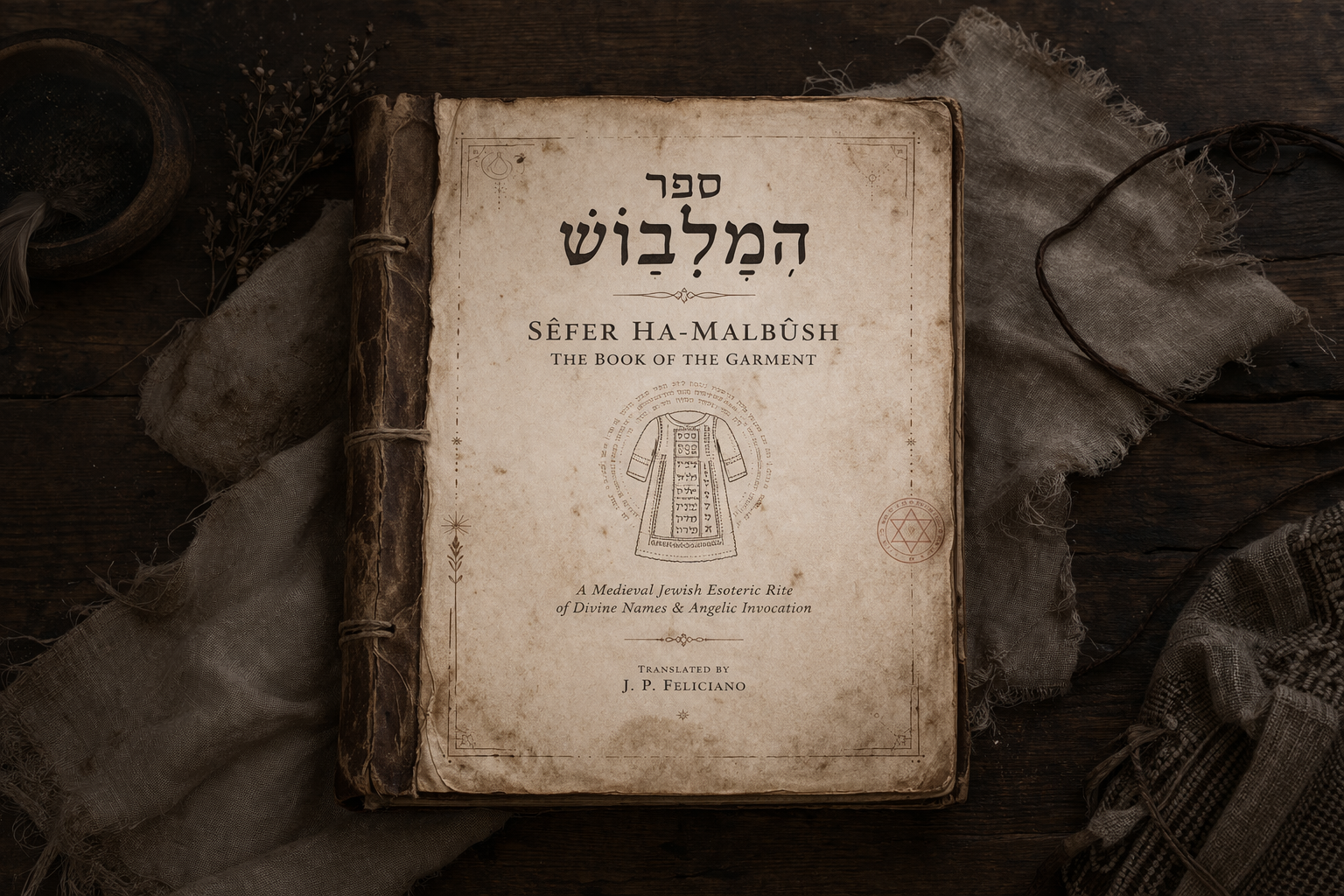
Before the Kabbalah became philosophy, before the Zohar became scripture, before the Tree of Life became a diagram—there was practical magic. There were rituals to evoke angels. There were procedures to "put on" the Name of God like a garment.
One of the most fascinating of these texts is the Sefer Ha-Malbush—the Book of the Garment. It describes how a practitioner can clothe themselves in divine names, immerse in water, and emerge wearing the power of God.
You have heard of Jewish mysticism. Kabbalah. The Zohar. The Tree of Life. But most of what you have encountered is theoretical—philosophy, theology, meditation. You have wondered: Where is the practical magic? Where are the rituals? Where are the angels you can actually call?
The answer is in the lesser-known texts of the Geonic period (6th-11th centuries). Texts like the Sword of Moses. Texts like the Book of the Garment. These are not philosophical treatises. They are instruction manuals. They tell you exactly what to do, what to say, what to wear, and what to expect.
This post introduces the Sefer Ha-Malbush—what it is, how it works, and what its ritual actually means.
The Sefer Ha-Malbush (Book of the Garment) is a Jewish esoteric text, likely originating in Babylonia during the Geonic period (6th-11th centuries), when Jewish communities thrived in that region.
The ritual at its core is called lebishat ha-shem—literally "putting on the Name." The practitioner seeks to impregnate their being with the Name or Names of God, usually by immersing themselves in water and reciting sacred names.
This is not a metaphor. The text describes actual procedures: fasting, purification, bathing, the creation of a special garment inscribed with divine names, and the evocation of angelic beings.
Another mystical work with the same title exists in the Sefer Raziel, but it is only distantly related. The ritual in this text is distinct and powerful.
THE CONTEXT—PUTTING ON THE NAME IN JEWISH MAGIC
The practice of "putting on the Name" appears throughout Jewish magical literature. It is a way of protecting the practitioner from dangerous spiritual forces while accessing higher realms.
In the Sword of Moses (another magical text from the Geonic era), we find an impressive ritual to evoke the Angel of the Presence. It begins with a procedure for putting on a holy name to protect the mystic from the fierce energy of the Angel and from punishing angelic beings.
The Sword of Moses instructs:
"In that hour when I wish to attach him to me and to employ him, I sit and fast on that very day; but prior to it one must keep oneself free for seven days from any nocturnal impurity, and must bathe in the fountain of water, and not speak at all during those seven days. At the end of this purification, on the day of the fast, he must sit in the water up to his throat, and before he utters the conjuration he must first say:
'I conjure you, angels of dread, fear, and shaking, who are appointed to hurt those who are not pure and clean... that you do not hurt me, nor terrify me, nor frighten me; verily, in the name of the powerful, the revealer of the mysteries.'
*After this he may commence his conjuration, for now he has fortified himself and has sealed himself with the name of God of 42 letters, before which all who hear it tremble and are frightened, and the heavenly hosts are terror-struck."*
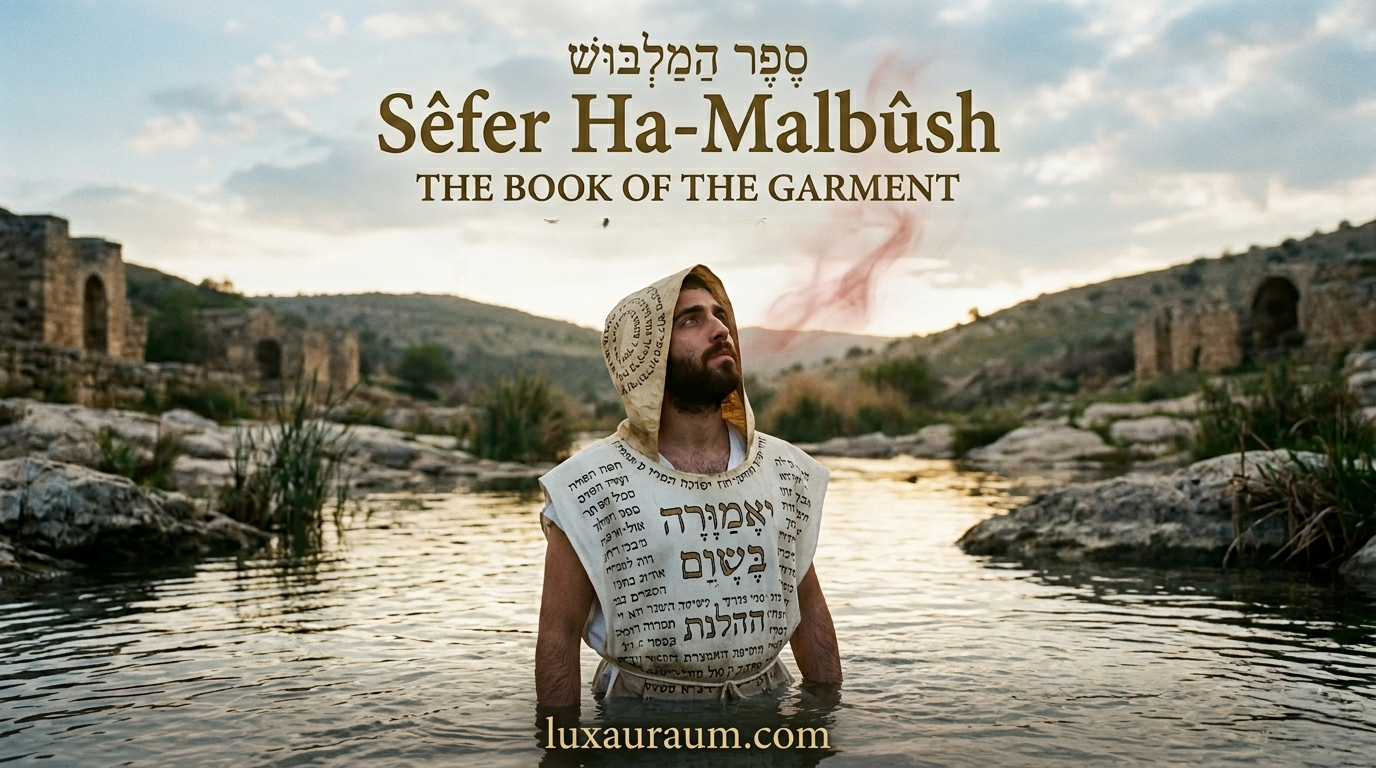
The Sefer Ha-Malbush presents a similar but more complex procedure. It requires a special garment (the me'il ha-tzedakah or "mantle of righteousness"), whereon divine names are written. The practitioner immerses himself in water to "put on" the Holy Name.
THE WATER ELEMENT—CONNECTION TO THE MIKVEH
The water immersion in these rituals likely traces back to the old Jewish ritual bath—the miqveh.
The miqveh was used for purification before entering the Temple, before certain sacred activities, and for conversion to Judaism. It represents death and rebirth—emerging from the water as a new being, pure and ready for contact with the divine.
In the Sefer Ha-Malbush, the water serves the same purpose. The practitioner immerses to become pure, to shed impurity, and to be ready to "wear" the Name of God.
Another variant of "Putting on the Name" appears among the Hasidei Ashkenaz—the early medieval German mystics who devoted themselves to the study of divine names and practical Kabbalah. Their most celebrated teacher, Eleazar of Worms, developed a rite for the transmission of divine names that involves both teacher and student standing in water in white garments while uttering prayers.
The pattern is consistent: water + purity + sacred names + special garments = access to divine power.
THE RITUAL OF THE GARMENT (Summary)
The Sefer Ha-Malbush describes a seven-day purification ritual culminating in the creation and use of a special garment inscribed with divine names.
The Preparation (Seven Days)
· Fast for seven days
· Maintain bodily purity (no contact with the dead, no contact with unclean things, no sexual relations with a menstruating woman)
· Bathe daily (or take a ritual bath each night)
The Garment
The practitioner takes gazelle parchment and weaves it into a garment similar to the breastplate of the Ephod (the high priest's ceremonial garment). The garment must cover the shoulders, belly, and down to the hips. A separate piece similar to a hood is also fashioned. No sleeves are required.
This is the "mantle of righteousness" (me'il ha-tzedakah).
The Names
The practitioner writes "great and terrible" names on both sides of the garment and another name on the hood. The text then provides the actual names—sequences of Hebrew letters that are intentionally difficult to transcribe and pronounce.
Among the names mentioned is the 42-letter name of God (the "Shem ha-Meforash" of 42 letters), before which all who hear it tremble.
The Water Immersion
On the seventh day, on the night of the eighth day, the practitioner goes to the waters and invokes the names over them.
Then a sign appears. The practitioner sees in the air, close to the water, the appearance of a form:
· If the form is green → the practitioner is in a state of impurity. They must fast another seven days and repeat the process.
· If the form is clear and red → the practitioner has become thoroughly pure.
Putting On the Name
Once purity is confirmed, the practitioner enters the water up to their waist, "vesting themselves in the glorious and terrible Name in water." Then they get out.
Now they are clothed in the Name.
The Result
The text promises:
"You may fight whomever you want, because everyone who sees you will see a great army with you."
The practitioner can invoke awesome angels to appear with them. The text names specific angels: AGRYR, AGRWR, GRHY, YHWTB, YHWTBAL, SMSHY, YRTT, YQTAL, LNPRYAL, AYNGRYAL, SRWKY, SDQYAL.
The practitioner sees "naught but smoke passing before them."
Powers Granted
The practitioner can:
· Bring forth rain or wind
· Have angels appear in any form they wish
· Call the angels for seven days, using the operation each day
Duration: The angels remain with the practitioner for no more than three or four hours at a time.
WHAT THIS MEANS FOR MODERN PRACTITIONERS
You are not expected to perform this ritual exactly as written. Gazelle parchment is not readily available. The Hebrew names are difficult to reconstruct. The purity requirements are intense.
But the principle remains valuable:
· Preparation matters. Seven days of fasting and purification is not arbitrary. It is a technology for shifting consciousness.
· Water is transformative. Immersion represents death and rebirth. It is a liminal space where the ordinary self can be shed.
· Clothing is symbolic. Putting on a special garment (or even a specific intention) changes how you act and how others perceive you.
· Names have power. The act of speaking, writing, or wearing sacred names focuses intention and activates neural pathways associated with reverence, awe, and altered states.
· Signs are internal. The green or red form seen in the water is not necessarily external. It is a psychological marker—a way for the practitioner to assess their own state of purity and readiness.
The modern version of "putting on the Name" might look like this:
1. Set aside time for purification (fasting, abstaining from certain activities, daily ritual bathing or cleansing)
2. Create a special garment or object (a robe, a pendant, a ring) that you dedicate to your spiritual practice
3. Inscribe or consecrate that object with a name or intention that carries meaning for you
4. Immerse yourself in water (a bath, a river, a shower) while focusing on that name
5. Emerge with the intention that you are "clothed" in that power
6. Act from that state
THE CAUTIONARY NOTE
The Sefer Ha-Malbush warns the practitioner: "Beware that you be not put to shame, for they shall remain with you for no more than three or, at the most, four hours."
Why this limitation? Because the human body and mind cannot sustain that state indefinitely. The "garment" must be removed. The practitioner must return to ordinary consciousness.
This is the wisdom of the text. It does not promise permanent angelic companionship. It promises temporary access—enough to accomplish a task, but not enough to lose yourself in the power.
The Sefer Ha-Malbush is not a text you will likely perform exactly as written. But it is a window into a forgotten world—a time when Jewish mysticism was not just philosophy but practice, not just meditation but magic, not just contemplation but evocation.
The Book of the Garment teaches that you can clothe yourself in divine power. Not by earning it, not by begging for it, but by preparing yourself to receive it—through purity, through intention, through sacred names, through water, through a garment that reminds you of who you have become.
You do not need gazelle parchment. You need the principle: prepare, purify, clothe yourself in intention, and act from that state.
The Name is within you. The garment is your own awareness. The water is your own willingness to change.
What will you put on today?
Sources cited:
· Sefer Ha-Malbush (Book of the Garment)
· Sword of Moses
· Sefer Raziel
· Hasidei Ashkenaz teachings
· Eleazar of Worms
· Miqveh tradition








Collective Insights
Be the First to Share
Your insights could spark meaningful conversations. Share your thoughts above!
Share Your Insight