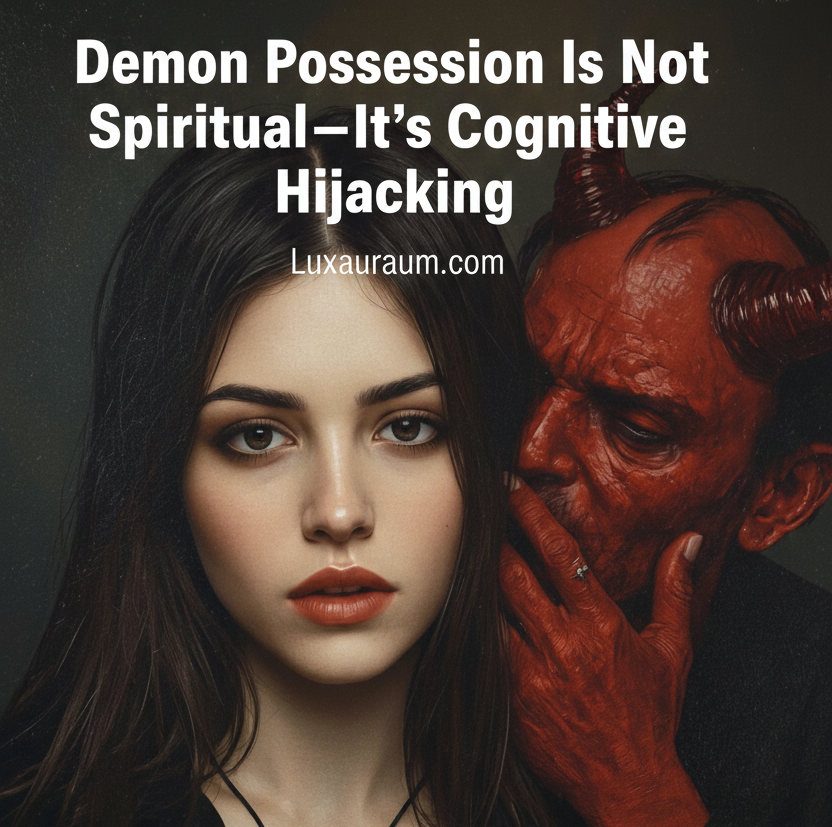
The Myth You Were Taught: Demons Enter People
You watch the news. A quiet neighbor does something inexplicably violent. A loved one falls into a cult, their personality erased. You see zealots commit atrocities in the name of God or cause. The explanation given is always the same: "They were possessed. The devil made them do it." This comforts you. It means the horror is out there—a supernatural enemy you can pray against. But a deeper, more terrifying doubt whispers: What if the possession is human? What if the demon is the person smiling at them, holding the holy book, wearing the uniform?
For thousands of years, humans have blamed unseen entities for human behavior.
Violence? A demon.
Sexual impulses? A demon.
Blasphemy? A demon.
Madness? A demon.
Priests used holy water.
Shamans used herbs and chants.
Occultists used seals and exorcisms.
But here’s the uncomfortable truth:
No scientific evidence has ever shown an external entity entering a human mind or body and controlling it.
Demon possession is real—
but not in the way religion and occultism taught you.
What “Demon Possession” Really Looks Like
Across cultures, possession shares the same core traits:
- Sudden personality changes
- Irrational or impulsive behavior
- Aggression or sexual disinhibition
- Hearing voices or feeling guided
- Amnesia or dissociation
- Hyper-religiosity or “holy” behavior
The labels change.
The brain mechanisms don’t.
The Occult Origin: Why Religions Invented Demons
Historically, demons served three functions:
- Social control – Explain deviance
- Power hierarchy – Priests control the cure
- Meaning-making – Humans externalize inner chaos
In medieval Europe, epilepsy was demonic.
In Africa, spirit possession explained trauma.
In Asia, ancestor spirits explained dissociation.
Different myths. Same brain.
The Cognitive Decoding: Possession as Neural Hijacking
1) Limbic System Takeover
When the amygdala and limbic circuits dominate, the prefrontal cortex (PFC) loses control.
Result:
- Rage
- Impulsivity
- Risky behavior
- Loss of moral inhibition
People say:
“Something took over me.”
Neuroscience says:
Your executive self went offline.
2) Dissociation and Fragmented Identity
Trauma and intense belief systems can split identity into ego states.
These parts can:
- Speak internally
- Feel like “not me”
- Take control during stress
This is dissociation, not spirits.
Religion called these parts demons, angels, or gods.
3) Inner Voices Are Normal—Until They Aren’t
The brain constantly generates internal dialogue.
Under stress, psychosis, or belief priming:
- Inner speech becomes intrusive
- Feels external
- Gains authority
The brain does not label thoughts as “self-generated” by default.
Culture interprets the voice.
Why Some “Possessed” People Are Calm, Holy, and Smiling
Possession isn’t always violent.
Some people enter:
- Religious ecstasy
- Hypomanic spiritual identity
- Hyper-moral “holy persona” states
The brain adopts learned archetypes.
If culture teaches “holy possession,” the mind plays that role.
If culture teaches “demonic possession,” the mind plays that role.
Cognitive Possession: The Real Demon
Here’s the radical truth:
Humans are possessed by cognitive architectures—beliefs, narratives, habits, ideologies, trauma, dopamine loops.
As we explored in Your Brain Is the Only Altar You’ll Ever Need, the brain constructs identity moment by moment.
A strong belief system can override free will more effectively than any mythical entity.
Why Exorcism “Works” (Sometimes)
Exorcism can reduce symptoms—not because demons leave—but because:
- Suggestion resets belief frameworks
- Social ritual stabilizes identity
- Authority primes cognitive compliance
- Stress release reduces dissociation
It’s placebo + narrative therapy in ritual form.
But it can also worsen symptoms by reinforcing fragmentation.
The Dark Side: Religious and Occult Manipulation
Possession narratives have been weaponized to:
- Control women and minorities
- Justify violence
- Suppress dissent
- Build priestly authority
- Create fear-based obedience
As we discussed in It’s Not Just What You Think—It’s What You Watch, media and religion can hijack cognition through fear and archetypes.
Demons were a governance technology.
THE SPIRITUAL & SCIENTIFIC ROOT (The Unvarnished Truth):
Demon possession, as taught by religions and feared by societies, is a myth. But what it describes is terrifyingly real. It is not, however, the invasion of an external spirit. It is the complete takeover of a human mind by a maladaptive psychological program.
This program—this "demonic software"—can be installed in three ways:
1. Traumatic Implantation: Severe, often repeated trauma (abuse, torture, war) can shatter the psyche's core identity. To survive, the mind fragments. These fragments, in extreme cases, can behave like autonomous "entities" with their own memories, behaviors, and voices—a condition psychology calls Dissociative Identity Disorder (DID). The "exorcism" of these parts is a tragedy; their integration through therapy is the true healing.
2. Ideological Download: This is the most common and dangerous "possession." A charismatic authority—a guru, a political leader, a radical cleric—uses proven techniques of coercive persuasion: love-bombing, isolation, control of information, induced fatigue, and fear. They systematically dismantle a person's old belief system ("the soul") and install a new one ("the doctrine"). The person's original personality is not fighting a demon; it has been overwritten. Their smile is the cult's smile. Their rage is the ideology's rage. This is Ideological Possession.
3. Voluntary Surrender: The "weak mind" you described. A person, through lack of cognitive training, surrenders their executive function—their Prefrontal Cortex, the "seat of the king"—to the loudest internal or external voice. The impulsive thought ("Kill him"), the cultural prejudice ("They are less than human"), the addictive craving, becomes the commander. This isn't a demon jumping in. This is the abdication of the throne of the self.
The "demon" is never the hissing, external monster. It is the code. And code is written by programmers.
How to Guard Against “Possession” (Scientifically)
Not with holy water.
Not with chants.
But with:
- Strengthening the prefrontal cortex (executive control)
- Emotional regulation training
- Trauma processing
- Critical belief auditing
- Reducing ideological echo chambers
Cognitive sovereignty is the only exorcism.
The Ritual of Source Identification
The old protection rituals—holy water, chants, amulets—are firewalls against fantasy hackers. You need a firewall against the real ones.
The Cognitive Sovereignty Protocol:
1. The Mirror of Origin: When you observe a "possessed" behavior—in yourself or another—freeze the narrative. Ask the ruthless question:
o "Who benefits from this belief?"
o "What system is reinforced by this rage or this passivity?"
o "Does this thought feel like me, or does it feel like a transmission?"
Trace the thought upstream. You are not looking for a ghost. You are looking for the first human who put it there.
2. The Firewall Declaration: Place your hands on your head. Feel your skull—the biological hardware. State aloud:
"This mind is sovereign territory. No program runs without my conscious consent. I audit all code. I revoke license from any belief that does not serve my holistic humanity. The only voice with ultimate authority is the one that questions all voices."
This is not a prayer. It is a root-access command to your own neurology.
3. The Disenchantment of the "Holy": Take any sacred text, any ideological manifesto, any guru's teaching you hold dear. Mentally place it on a table. Say:
"You are a document written by humans. You contain wisdom and poison. I will extract the one and neutralize the other. Your authority is granted by my consciousness, and it can be revoked."
You have just broken the first and most powerful spell.
THEN TAKE ACTION: The Three Laws of Psychic Hygiene
You've identified the real threat. Now you must build a society—and a self—that is resistant to infection.
1. Law of Cognitive Sovereignty (Personal): Train your biological "exorcism" tools.
o Strengthen the Prefrontal Cortex (The King): Daily meditation, complex problem-solving, delaying gratification.
o Audit Your Beliefs (The Code Review): Weekly, journal: "What is one belief I hold that I have never truly chosen? Where did it come from? Does it still serve me?"
o Practice Reality-Testing (The Debugger): Before acting on a strong impulse, ask: "Is this my desire, or a desire implanted by my trauma, my culture, my advertiser, my leader?"
2. Law of Anti-Manipulation Detection (Social): Identify the Programmers in your life.
o The Love-Bomber: Who showers you with affection to lower your boundaries?
o The Isolator: Who subtly cuts you off from other sources of information and support?
o The Fear-Mongerer: Who gains your loyalty by presenting themselves as the only shield against a terrifying enemy?
o The Exhaustion Agent: Who keeps you in a state of crisis, fatigue, or poverty where critical thought is impossible?
Your new ritual: Disengage from the Programmer. Not with drama, but with silent, firm withdrawal.
3. Law of Responsible Influence (Ethical): Acknowledge your own power to "possess."
o As a parent, leader, or friend, you are installing code every day. Ask:
o "Am I teaching obedience or critical thinking?"
o "Am I offering a dogma or a toolkit?"
o "Do I want followers, or sovereign allies?"
The greatest exorcism is to refuse to become a demon in someone else's story.
Why People Will Hate This
Because you are removing:
- Priestly authority
- Mystical fear
- Occult mystique
- Religious monopoly on meaning
You are saying:
“The demon was never outside. The architecture was always inside.”
That destabilizes power structures built on fear of unseen forces.
For millennia, the myth of external demonic possession has been the ultimate tool for
social control and absolution.
· It pathologizes dissent: The heretic isn't reasoned with; he's "possessed."
· It excuses atrocity: The soldier wasn't responsible; "the demon of war made him do it."
· It preserves corrupt systems: The problem is never the abusive priest or the toxic ideology; it's the "devil" they're conveniently fighting.
To admit that "possession" is human-made psychology is to bring the accountability home. It means:
· Cult leaders are the real demons.
· Traumatizers are the real exorcists, casting out their victim's sanity.
· The "holy voice" in your head is often just the echo of the first person who scared you into submission.
Conclusion:
This is what happens in the brain during evocation. Whether this is all that happens, or whether the brain is also interacting with something else, remains an open question. Science describes the mechanism of experience, not necessarily the full nature of reality.
Demons Are Cognitive Architectures Wearing Mythological Masks
Demon possession is not supernatural invasion.
It is cognitive possession—when narratives, trauma, impulses, and beliefs override the executive self.
The ancients encoded this as demons because they lacked neuroscience.
Modern humans keep the myth because it maintains power hierarchies.
The real battle isn't between heaven and hell. It's between the programmed mind and the sovereign mind. Between the self that is a vessel for someone else's code and the self that is the author of its own being.
They told you to fear the demon that jumps into the body. You should fear the human who implants the idea that you are just a body that can be jumped into.
The most profound "exorcism" in history will be the day humanity collectively realizes: the only spirits we need to cast out are the ones we obediently invited in, and then called holy.
The altar is not where you fight demons. The altar is the space between your thoughts where you choose which ones to believe. Who controls that space?
The real exorcism is consciousness literacy.
And the real demon is unexamined cognition.



Collective Insights
Be the First to Share
Your insights could spark meaningful conversations. Share your thoughts above!
Share Your Insight