
Two people experience the same event—a critical comment, a financial setback, a rainy day—and have completely different reactions. One is crushed; the other is motivated. You know you "see things differently," but it feels like a personality trait you're stuck with, not a system you can control. You're tired of reacting to life on autopilot, watching the same negative patterns replay, feeling like your own mind is working against you.
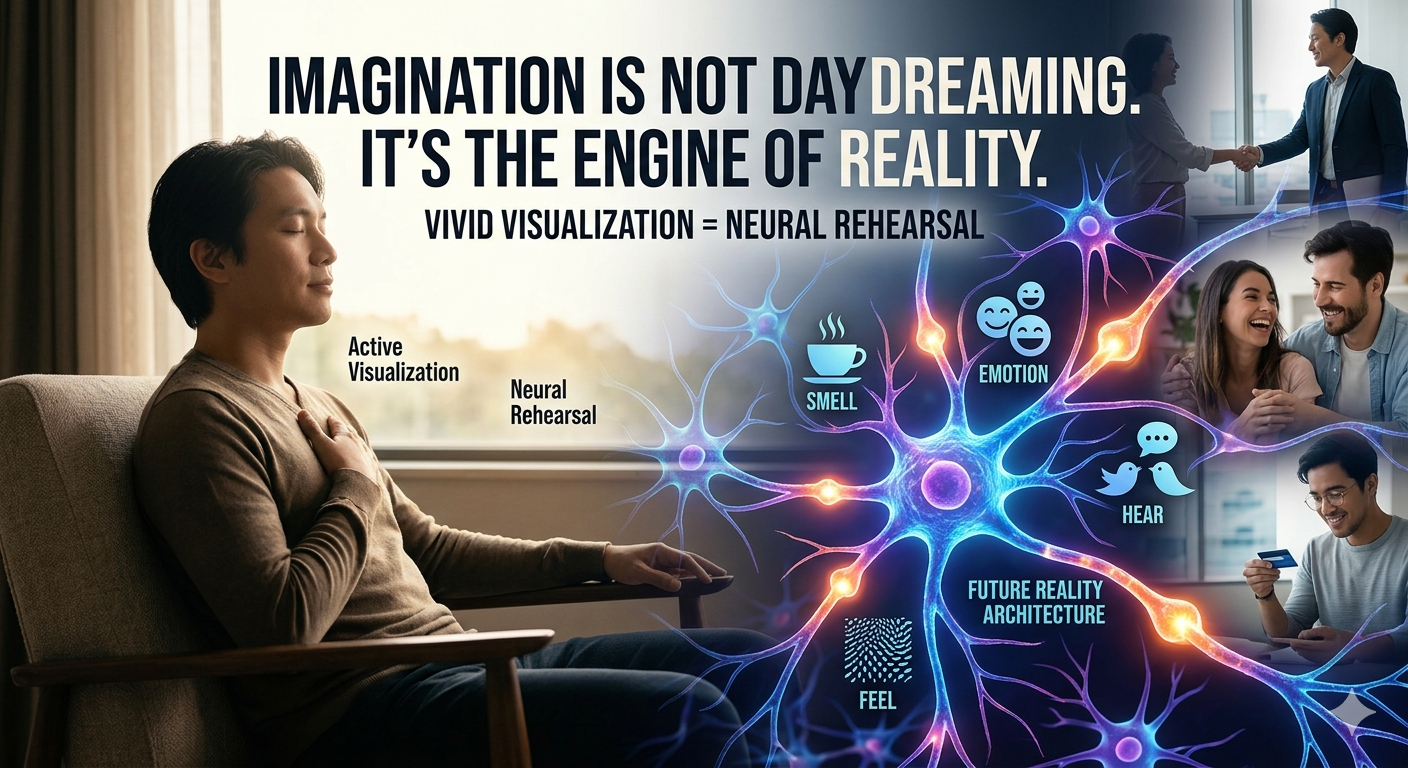
This happens because you never experience reality directly. What you experience is your brain's best guess, a high-speed simulation built from past experiences, beliefs, and current bodily states. Your consciousness isn't a camera recording the world—it's a predictive projector throwing an interpretation onto the blank screen of raw sensory data.
This is the Psychology of Perception, and it's the most practical spiritual truth you'll ever learn. Your "mindset" isn't just positive thinking; it's the algorithm your brain uses to construct your moment-to-moment reality. A mind programmed with "I am unsafe" doesn't just feel anxious—it literally constructs a world full of threats by filtering its perception to confirm that belief.
Your world isn't happening to you. It's being generated by you, in real-time.
The "Reality Reboot" Ritual
This ritual isn't about changing the world. It's about rebooting the projector. You're going to interrupt the automatic simulation and force a new one.
The 4-Minute Sensory Reset:
- The Freeze (Interrupt the Loop): The next time you're triggered (by anger, anxiety, overwhelm), FREEZE. Don't react. Say aloud: "This is a perception. It is not the truth." This verbal command activates your prefrontal cortex, wresting control from the automatic emotional loop.
- The Data Download (Gather Raw Input): For 60 seconds, become a scientist collecting pure sensory data:
- Sight: Name 5 colors you see. Not objects ("a chair"), but colors ("brown, beige, gray, green, black").
- Sound: Identify 4 distinct sounds. Not interpretations ("annoying traffic"), but raw noise ("a hum, a bird chirp, a distant thump, my breath").
- Body Sensation: Scan for 3 physical feelings. Not emotions ("anxiety in my chest"), but sensations ("tightness, warmth, pulse").
- The Re-Narration (Install a New Filter): Now, take the same sensory data and narrate it through a deliberately chosen filter. Whisper:
- Filter of Curiosity: "I am witnessing a complex moment with interesting data."
- Filter of Safety: "I am in a space where I can observe this without danger."
- Filter of Growth: "This is feedback my system is giving me to learn from."
- You haven't changed the event. You've changed the meaning-making software processing it.
- The Choice Point: Finally, ask: "From this new vantage point, what is one tiny, possible action?" The action is irrelevant. The power is in experiencing that your perception is a choice, not a sentence.
The Perception Engineer's Daily Protocol
Now that you know you can reboot the system, you must consciously reprogram it.
- The Morning Filter Installation (90 Seconds): Each morning, choose your primary perceptual filter for the day. Write it down. Examples:
- "Today, I filter for evidence of competence."
- "Today, I filter for moments of connection."
- "Today, I filter for hidden opportunities."
- This programs your Reticular Activating System (RAS)—your brain's spotlight—to notice what matches your filter and ignore what doesn't.
- The Evening Perception Audit (5 Minutes): Review your day not by events, but by perceptions.
- Event: "My boss was short with me."
- Old Automatic Perception: "She's unhappy with me; I'm failing."
- Engineered Alternatives: "She's under pressure." / "This is about her timeline, not my value." / "I can ask for clarity tomorrow."
- You are building a menu of perceptions for every trigger, weakening the automatic one.
- The Environment Remix (Weekly): Your environment is a perception machine. For one hour this week, alter one input channel to feed a new filter.
- If you filter for anxiety, listen to a podcast on neuroscience (framing anxiety as energy, not danger).
- If you filter for scarcity, walk through an affluent neighborhood not with envy, but with the curiosity of an anthropologist studying abundance.
- You are not changing your life; you are gathering new data to prove to your brain that other perceptions are possible.
Most spiritual teachings tell you to "change your thoughts" without showing you the mechanics. They treat the symptom, not the system.
This works because it targets the perceptual machinery itself:
- The Freeze breaks the amygdala hijack.
- The Data Download forces the brain into sensory present-moment awareness, disrupting the predictive loop.
- The Re-Narration utilizes cognitive reframing, a proven therapeutic technique.
- The Protocol leverages neuroplasticity through consistent repetition.
You are not fighting negative thoughts. You are downgrading your old perception from 'absolute truth' to 'one of many possible simulations.' Once you see the projector, you can change the film.
The most powerful person in any room isn't the one with the most resources. It's the one who understands that the room they're experiencing is, in large part, a construction of their own mind. And if you can construct a room, you can redesign it.
You have been living in a house of mirrors, believing them to be windows. The first step to freedom isn't breaking the mirrors. It's recognizing they're mirrors.
What's one situation where you're ready to change the filter and see what new reality renders?






Collective Insights
Be the First to Share
Your insights could spark meaningful conversations. Share your thoughts above!
Share Your Insight