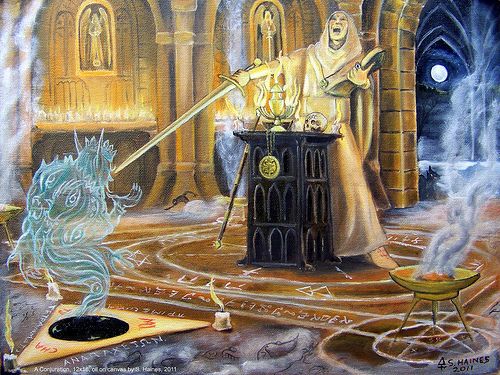
You sit in the dark triangle. The incense burns. You chant names from old grimoires—Bael, Paimon, Asmodeus. Your heart races. The air feels thick. And then... something shifts. A presence. A pressure. A voice not your own.
For centuries, you've been told this is an external entity answering your call. A demon arriving from some spiritual dimension to bargain, serve, or terrify.
But what if the entity was never "out there"? What if the entire experience—the presence, the voice, the pressure—is being generated inside your own skull by predictable, measurable brain mechanisms?
And more importantly: What if knowing this makes your practice more powerful, not less?
THE SCIENTIFIC TRUTH (Hard Evidence, No Gimmicks):
Let me be clear from the start: No fMRI scanner has ever detected a demon entering a human brain. No PET scan has ever lit up an "external entity interface." The search results on this topic are explicit—neuroscience has found no evidence for literal supernatural possession .
But here's what neuroscience HAS found:
When practitioners enter ritual states—whether Goetic evocation, shamanic journeying, or religious trance—their brains show highly specific, repeatable patterns of activation . These patterns explain exactly what's happening when you "see" a demon, "hear" its voice, or "feel" its presence.
Let me walk you through the brain scan of a demon evocation—what's actually lighting up, and why it matters.
THE BRAIN SCAN THEORY: What's Happening Inside Your Skull
Stage 1: The Preparation (Pre-Ritual Arousal)
Before you even enter the circle, your brain is already changing.
What you feel: Anticipation. A slight nervousness. The weight of the working.
What's happening in your brain:
- Your amygdala and anterior cingulate cortex activate, preparing your threat-detection systems
- Your sympathetic nervous system kicks in—heart rate increases, pupils dilate, adrenaline flows
- This is the same physiological state as before a high-stakes performance, not "opening a portal"
This pre-ritual arousal is critical—it primes your brain to interpret ambiguous stimuli as meaningful. You're not becoming more "spiritually sensitive." You're becoming more neurologically suggestible .
Stage 2: The Invocation (Focused Attention + Sensory Manipulation)
Now you're chanting. Maybe staring into a dark mirror or triangle. The grimoire's instructions—"gaze steadfastly," "repeat the names without ceasing"—aren't random. They're precise psychological technologies.
What you feel: The shift. Time distorts. Your focus narrows.
What's happening in your brain:
A. The DMN Quiets
Your Default Mode Network (DMN) —the part of your brain responsible for your sense of "self," autobiographical memory, and internal monologue—begins to decrease in activity . This is measurable. The posterior cingulate cortex (PCC), a major DMN hub, shows reduced centrality during intense focus states .
Translation: Your normal "I am me" boundary begins to dissolve. The voice in your head that constantly narrates your experience goes quiet. You feel less like a separate self and more like... presence. This is the neural basis of the "expanded consciousness" mystics describe.
B. The Control Network Takes Over
Simultaneously, your executive control network (insula, anterior cingulate) increases its activity . This seems paradoxical—you're "letting go" while also intensely focused. But this is precisely the state of effortless effort athletes call "flow." Your brain is maintaining laser focus while dissolving the ego that normally gets in the way.
C. The Auditory System Gates Out
When you chant repetitively for extended periods, your brain's auditory processing regions begin to gate out the predictable sound . The chanting becomes background. But here's the key: your brain, freed from processing external input, starts generating its own internal patterns.
Stage 3: The Appearance (Perceptual Construction)
The triangle darkens. The mirror shifts. A face forms. A presence announces itself.
What you feel: The demon is there. Real. External. Speaking.
What's happening in your brain:
This is the most misunderstood moment in all of occultism. Let me break it down with precision.
The Neural Mechanism of "Seeing" a Demon:
- Sensory degradation: The dark mirror, the triangle, the dim light—all intentionally degrade the quality of visual input. This is not decorative; it's operational. When your brain receives poor visual data, it doesn't just accept the blur. It fills in the gaps based on expectation and memory .
- Probabilistic perception: Your brain is not a camera. It's a prediction engine. It constantly generates "best guesses" about what you're seeing based on past experience and current expectation. When visual input is degraded (by darkness, fatigue, or trance), your brain's predictions become louder than the actual sensory data .
- The ciliary muscles strain: Ancient scrying techniques explicitly instructed practitioners to stare without blinking until the eyes strained. This wasn't mysticism—it was optics. When your eye muscles (the ciliary muscles controlling lens focus) are overworked, sharp focus becomes impossible. The visual image degrades further, giving your prediction engine even more room to construct .
- Rhodopsin amplification: In extremely dim light, your eyes activate rhodopsin (visual purple)—a system designed to amplify every available photon. This makes you maximally sensitive to the degraded, shifting image before you .
- The flickering candle: The grimoire says to hold a candle while scrying. This introduces constant, subtle movement in the reflection. Your brain's perceptual system, designed to detect change, now works overtime updating its model—creating the illusion of a living, moving entity .
The result: What you "see" is not an external demon. It's your own brain's best-guess visualization of the entity you've spent weeks studying, visualizing, and invoking. You've built the neural circuitry for "Paimon" through repetition and focus. Now, in trance, that circuitry generates the experience.
Stage 4: The Communication (The Voice That Is Not Your Voice)
The demon speaks. It gives you information—sometimes things you couldn't possibly know.
What you feel: A distinct, separate intelligence communicating through you.
What's happening in your brain:
The Dissociated Self Phenomenon:
When your Default Mode Network (sense of self) quiets, and your executive control network remains active, a strange thing happens: internally generated thoughts can feel external.
This is the same mechanism behind:
- Hearing voices in psychosis (aberrant source-monitoring)
- Inspiration (the "muse" speaking through the artist)
- Automatic writing (the hand moves "on its own")
Your brain has a source-monitoring system that normally tags internally generated thoughts as "mine" and externally perceived stimuli as "not mine." In deep trance, that tagging system can misfile. A thought you generate, from the depths of your own subconscious, gets tagged as "external" .
The result? You hear a voice that is clearly not your conscious mind. Because it isn't your conscious mind—it's your subconscious, speaking in the symbolic language you've programmed it with through ritual.
But what about information you didn't know?
This is where it gets genuinely fascinating. Your subconscious mind processes information your conscious mind never registered. It notices patterns, stores forgotten details, and makes connections below awareness. When it speaks in trance, it can access this data—producing "revelations" that feel like external intelligence .
The demon isn't telling you the future. It's telling you what your own subconscious has already observed, synthesized, and now delivers in the voice of the archetype you've invoked.
Stage 5: The External Results (When "Magic" Happens in the World)
This is the question many always ask: How does this internal process result in external change—the enemy suffering misfortune, the opportunity appearing, the synchronicity manifesting?
The answer is not supernatural. It's social and psychological law.
When you successfully evoke and integrate a demonic archetype, you have fundamentally rewired your own neural circuitry . Let's use Gevurah (from our previous post) as the template:
The Sequence:
- Ritual activation: You evoke a demonic force associated with Gevurah—say, a Goetic spirit of boundary enforcement and righteous anger.
- Neural rewiring: Through focused attention, repetition, and emotional charge, you strengthen the neural networks associated with assertiveness, boundary-setting, and sovereign self-protection. This is measurable neuroplasticity .
- Subconscious reprogramming: Your basal ganglia (habit center) and limbic system (emotional memory) now operate with a new default. You no longer have to think about being assertive—your body does it automatically .
- Behavioral change: You stand differently. Your voice carries different weight. Your eye contact shifts. You stop broadcasting "victim frequency." People sense this change unconsciously.
- Social reality shifts: The person who was targeting you—consciously or unconsciously—now encounters someone who is not a soft target. Their behavior changes. Their own destructive patterns, no longer absorbed and buffered by you, rebound to their source.
- The "magical" result: Weeks later, you hear they lost their job, got sick, or self-destructed. You attribute it to your evocation. In truth, you simply stopped being a container for their chaos, and their chaos consumed them.
This is not supernatural. This is system dynamics applied to human psychology.
THE FULL EVIDENCE TABLE: What Scans Actually Show

Ritual ElementBrain RegionMeasurable EffectSourceRepetitive chantingPosterior cingulate cortex (PCC)Decreased centrality, increased delta wavesTrance inductionInsula, anterior cingulateIncreased connectivity in control networksDrumming/rhythmic soundAuditory pathwayGated out, reduced processingSensory deprivationVisual cortex, parietal lobeIncreased internal pattern generationEmotional arousalAmygdala, hypothalamusNeurotransmitter release (dopamine, serotonin, endocannabinoids)Archetypal invocationWhole-brain networksCoordinated activation across multiple regions
THE FORUM DEBATE: Why This Matters
There's an old debate in occult circles that perfectly captures the tension here. One practitioner argued that we could study Goetic evocation with PET scans, EEG, and MRI—gathering neurological data to understand how sigils relate to results, and perhaps design more effective rituals .
Another responded: "I cannot imagine how this could be worked in practice. Magick requires concentration, not the distraction of an array of sensors on one's head" .
But the first practitioner's response is worth quoting at length:
"Synchronicity would seem to be a case of cognitive dissonance, which is a subject for cognitive neuroscience. Subtle effects would be changes in attention, cognitive style, affect, perceptual priority, syntactic processing, semantic valuations, etc. Which are also the subject of neuroscience" .
He continues: "Any correlations between neurological changes and actual changes in environmental factors, ambient temperature, electrical charge, radiation, etc. is a task for physicists. Changes in heart rate, breathing, metabolism, etc. the task of biologists. Certainly a team of these can be employed" .
This is the vision: understanding the complete mechanism of ritual, from neuron to environment, without losing the power of the practice itself.
THE OBJECTION (And Why It's Wrong)
Some practitioners will object: "All phenomena are physical phenomena? No. To limit 'all phenomena' to the physical manifestation is very obtuse. All phenomena streams from Atziluth (the spiritual world) and manifests physically in Assiah (the physical world)" .
Here's the hard truth response:
Whether you believe phenomena stream from spirit into matter, or emerge from matter as spirit, the physical manifestation is identical. The brain scan looks the same either way.
If the demon is "real" in some non-physical sense, it still must interface with your physical brain to be experienced. That interface leaves a measurable trace. By studying that trace, we learn how to make the interface more effective.
You can maintain your metaphysical beliefs and use neuroscience to refine your practice. The two are not mutually exclusive. They are different languages describing the same event .
WHAT THIS MEANS FOR YOUR PRACTICE (The Practical Conclusion)
If demon evocation is a technology for rewiring your own neural architecture and reprogramming your subconscious, then:
- Preparation matters more than ever. The clearer your intention, the more precise the neural change.
- Repetition is not optional. Neuroplasticity requires repeated activation. One ritual won't rewire a lifetime of patterns.
- Symbols are engineering tools. They're not decorative—they're the precise "code" your subconscious uses to build new circuits.
- The results come through you, not to you. External change follows internal reorganization. You don't "make" your enemy suffer—you stop absorbing their poison, and it returns to them.
- Integration is the real "banishing." Closing the ritual isn't about dismissing spirits—it's about sealing the neural changes into long-term memory so they become your new baseline.
- You can test this. Keep a journal. Note your behavioral changes before noting external synchronicities. Track the sequence. You'll find the internal always precedes the external.
The demon you evoke is real. But its reality is not "out there" in some supernatural dimension—it's in here, in the depths of your own psyche, given form by your focused attention, given voice by your subconscious, given power by your willingness to integrate it.
The ancients didn't know about the Default Mode Network. They didn't have fMRI machines. But they mapped the territory with the tools they had—symbol, ritual, and generations of introspective observation. They called the results "demons" and "angels" because those were the best available metaphors.
We now have better metaphors. We can see what's actually lighting up. We can measure what's actually changing. And when we do, the practice doesn't become less powerful—it becomes more precise.
You're not summoning an external entity. You're summoning a part of yourself that was never allowed to speak before. And when that part finally speaks, when it's finally integrated, you become more whole, more sovereign, more powerful.
That's not less than magic. That's the point of magic.
The demon was never the enemy. The demon was the exiled part of your own soul, waiting at the door, hoping you'd finally have the courage to let it in.
What's one "demonic" part of yourself you've been too afraid to evoke?




Collective Insights
Be the First to Share
Your insights could spark meaningful conversations. Share your thoughts above!
Share Your Insight