You eat well, exercise, take supplements—yet you're still tired, brain-fogged, and prone to illness. You stay up late scrolling, sleep in on weekends, and wonder why you never feel fully rested. You've accepted that fatigue is just part of modern life.
But what if the problem isn't what you're doing, but when you're doing it?
You've likely heard the pineal gland called the "seat of the soul," the "third eye," or the gateway to enlightenment. Spiritual circles have built entire systems around "activating" this tiny gland. Here's the truth: your pineal gland is real, it's important, but its function is not what you've been told.
The pineal gland produces melatonin in response to darkness. That's its primary job. It's a time-keeper, not a psychic antenna. When it's healthy, you sleep well, your circadian rhythm functions, and your body repairs itself. When it's calcified or suppressed (by lack of darkness, blue light at night, fluoride, or poor sleep), you don't lose your "spiritual connection"—you lose sleep, energy, and metabolic health.
The real "third eye" is not in your pineal gland. It's in your prefrontal cortex—the part of your brain that sees patterns, makes conscious choices, and directs your life with intention. That's where enlightenment happens: in the choices you make, the awareness you cultivate, and the life you build. Not in a gland the size of a grain of rice.
Honor your pineal gland by sleeping in darkness. Honor your prefrontal cortex by using your waking hours wisely. Both matter. Neither is magic.

Circadian Rhythms Actually
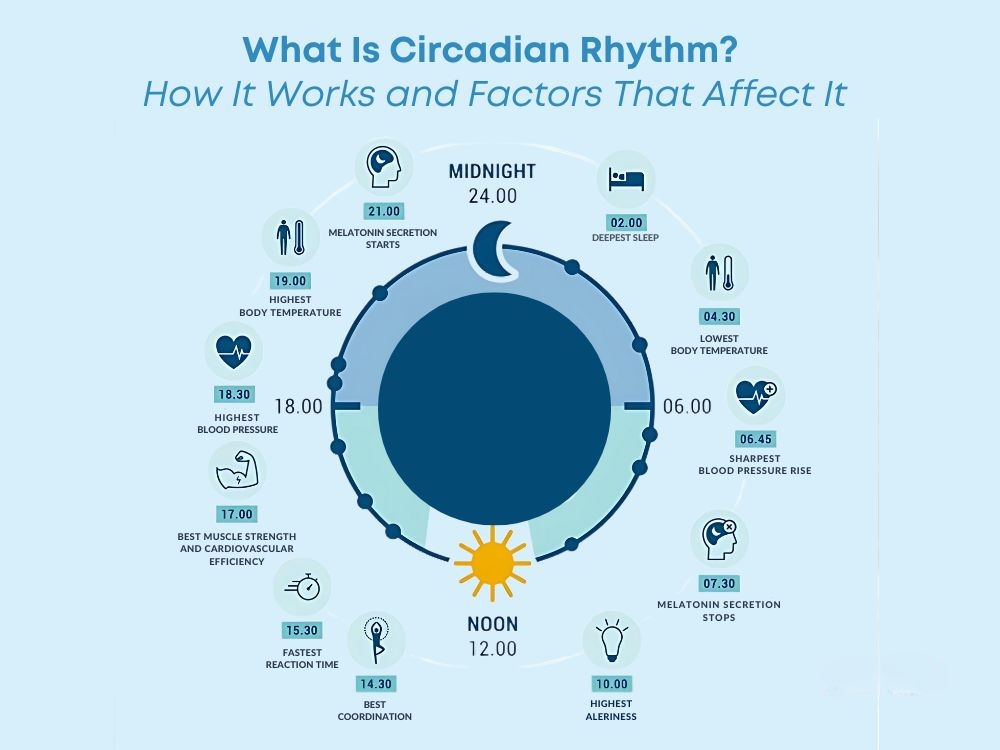
Every cell in your body contains a molecular clock. These clocks are synchronized by a master clock in your brain—the suprachiasmatic nucleus (SCN) , located just above where your optic nerves cross.
This master clock runs on roughly a 24-hour cycle. It's set by the primary time-giver: light.
Here's what your circadian rhythm controls:
1. Hormone release:
· Cortisol peaks in the morning to wake you
· Melatonin rises at night to make you sleepy
· Growth hormone releases during deep sleep for repair
· Leptin and ghrelin regulate hunger throughout the day
2. Body temperature:
Your temperature drops at night (signaling sleep) and rises before morning (preparing for wakefulness).
3. Metabolism:
Your digestive enzymes, insulin sensitivity, and gut motility all follow daily rhythms. Eat at the wrong time, and your body processes food poorly.
4. Immune function:
Immune cells have clocks. They're more active at certain times. This is why you often feel sicker at night—your immune system is ramping up.
5. Gene expression:
Thousands of genes turn on and off in daily cycles. When your rhythm is disrupted, gene expression goes haywire—contributing to cancer, diabetes, and depression.
WHAT HAPPENS WHEN YOUR RHYTHM IS DISRUPTED:
Modern life is a circadian disaster:
· Artificial light after sunset suppresses melatonin
· Blue light from screens tricks your brain into thinking it's daytime
· Irregular sleep schedules confuse your master clock
· Eating late at night disrupts metabolic rhythms
· Jet lag, shift work, and social jet lag (weekend sleeping in) desynchronize your system
The health consequences are not minor:
· Obesity: Late eaters gain more weight on the same calories
· Diabetes: Insulin resistance increases when you eat against your rhythm
· Heart disease: Blood pressure and heart rate rhythms protect your heart; disruption stresses it
· Cancer: Shift workers have higher rates of breast and colon cancer
· Depression: Mood disorders are strongly linked to circadian disruption
· Dementia: Alzheimer's patients have severely disrupted circadian rhythms
· Accelerated aging: Telomeres shorten faster with circadian disruption
The hard truth: You cannot out-supplement, out-exercise, or out-will a broken circadian rhythm. It's the foundation. Everything else is built on it.
The Circadian Alignment System
The Morning Practices (Set Your Clock):
1. Morning Light (Within 30 Minutes of Waking)
Get sunlight in your eyes—not direct sun, but outdoor light. Cloudy light works. Through a window works less well (glass blocks some wavelengths). This single act sets your master clock for the entire day.
Why: Light hits your retina, signals the SCN, and suppresses any remaining melatonin. It also sets a timer: approximately 14-16 hours later, your body will naturally produce melatonin.
2. Morning Movement
Light exercise in the morning reinforces the wake signal and raises body temperature, which helps set the rhythm.
3. Consistent Wake Time (Even on Weekends)
Sleeping in on weekends creates "social jet lag"—the equivalent of flying to a different time zone and back every week. Keep wake time within one hour, every day.
The Daytime Practices (Maintain the Rhythm):
1. Eat Within a 10-12 Hour Window
Your digestive system needs rest. Eating from 8am to 8pm (12 hours) is good. 8am to 6pm (10 hours) is better. No food 3 hours before bed.
2. Get Daylight Exposure Throughout the Day
Indoor light is too dim to maintain your rhythm. Take breaks outside. Walk during lunch. Your cells need to know it's still daytime.
3. Caffeine Cutoff (8-10 Hours Before Bed)
Caffeine blocks adenosine, the chemical that builds sleep pressure. Half-life is 5-6 hours. Afternoon coffee can still disrupt midnight sleep.
The Evening Practices (Prepare for Rest):
1. Dim Lights (2-3 Hours Before Bed)
Lower overhead lights. Use lamps. Candles are ideal. This signals your brain that night is coming.
2. No Screens (90 Minutes Before Bed)
Blue light from screens suppresses melatonin. If you must use screens, use night mode and dim brightness—but nothing beats no screens.
3. Cool Room (65-68°F)
Your body temperature drops to initiate sleep. A cool room supports this. Hot rooms disrupt deep sleep.
4. Complete Darkness
Blackout curtains, eye mask, or both. Cover LED lights from electronics. Even small amounts of light reach your retina through closed eyelids and disrupt sleep quality.
5. Consistent Bedtime
Same time every night, within 30 minutes. Your body loves predictability.
THE QUESTION ABOUT DIM LIGHTS AT NIGHT:
You may be asking: "Can I have a dim light in the room just in case I wake in the middle of the night and need to see the environment?"
Yes, but with conditions.
The Rule:
· Red or amber light only. These wavelengths do not suppress melatonin. Red night lights are available specifically for this purpose.
· Blue or white light (even dim) suppresses melatonin. A standard phone screen on lowest brightness still emits blue light.
· Motion-activated path lights that briefly illuminate the floor are better than continuous light.
· If you must use a light, keep it low to the ground and pointing away from your face. Light hitting your eyes is the problem.
The ideal: Complete darkness while sleeping. If you wake and need to navigate, use a red flashlight or red night light. Your eyes will adapt.
THE WEEKLY PRACTICES:
Sunset Viewing (Weekly):
Watch the sunset. It signals your brain that day is ending. The red wavelengths at sunset are different from midday blue light—they actually help transition to night.
Nature Exposure (Weekly):
Spending time in natural light-dark cycles (camping) resets your rhythm completely. Even one weekend camping can synchronize your clock.
Digital Sunset (Daily):
Choose a time—say, 9pm—after which you do not use any screens. Read a physical book. Talk. Stretch. Let your brain remember what night feels like.
HOW YOU KNOW IT'S WORKING:
Within one week:
· Easier to wake up
· More energy in the morning
· Naturally tired at bedtime
· Sleep feels deeper
Within one month:
· Mood improves
· Digestion regulates
· Cravings decrease
· Mental clarity increases
· You need less caffeine
Within three months:
· Weight may normalize
· Immune function improves
· Chronic inflammation markers drop
· You feel "in sync" with your days
Your body evolved over millions of years under a single condition: bright days, dark nights. In the last century, we've flipped that completely. We live in perpetual twilight—dim days from indoor light, bright nights from screens.
Your biology hasn't caught up. It's still running ancient software in a modern environment, and it's crashing.
The solution is not a pill. It's not a supplement. It's not a complicated protocol.
It's light in the morning. Darkness at night. Regularity in between.
Your ancestors didn't need to "optimize" their circadian rhythms. They lived them. You have to consciously choose them.
Every cell in your body is waiting for you to remember what time it is.
What's one circadian practice you'll start tonight?




Collective Insights
Be the First to Share
Your insights could spark meaningful conversations. Share your thoughts above!
Share Your Insight