You look in the mirror and see someone older than you feel inside. Your energy isn't what it used to be. Recovery takes longer. You're getting sick more often. You've accepted that aging is inevitable—but a part of you suspects it shouldn't happen this fast.
You've tried the creams, the supplements, the trendy diets. Nothing seems to address the root. You feel like you're watching yourself decline in slow motion, powerless to stop it.
What if aging isn't just time passing? What if it's a process—one you can influence at the deepest level of your biology?
THE SCIENCE (What Telomeres Actually Are):
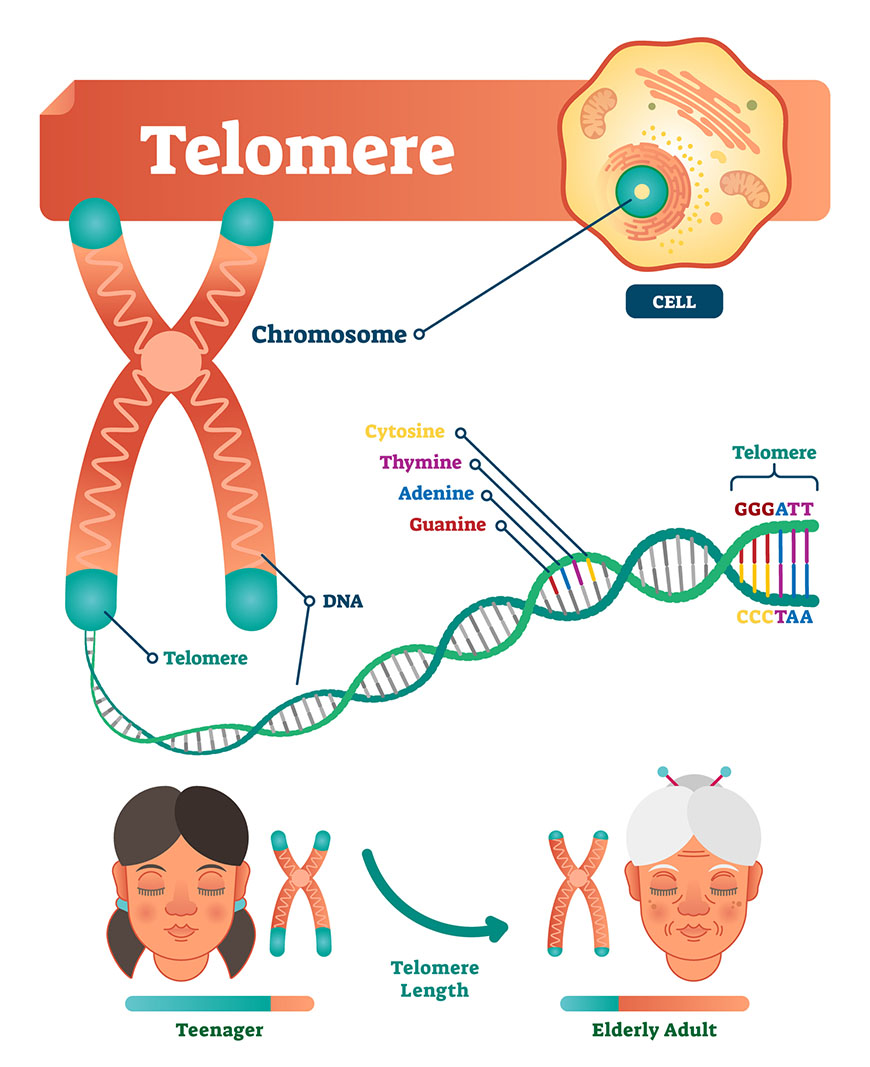
At the ends of your chromosomes are tiny protective caps called telomeres. Think of them like the plastic tips on shoelaces—they keep your DNA from fraying and unraveling. Every time your cells divide, these telomeres get a little shorter.
When telomeres become too short, your cells can no longer divide. They become senescent—"zombie cells"—or they die. This is aging at the cellular level. It's not wrinkles and gray hair; it's the breakdown of your body's ability to renew itself.
Here's what determines how fast your telomeres shorten:
1. Cellular division rate: The more your cells divide, the faster telomeres shorten. This is why chronic inflammation—which forces constant cell turnover—accelerates aging.
2. Oxidative stress: Free radicals attack telomeres directly. Poor diet, pollution, and mental stress all increase oxidative stress.
3. Telomerase activity: Your body produces an enzyme called telomerase that can rebuild and lengthen telomeres. It's the only known mechanism for actually reversing cellular aging. The question is: what turns telomerase on and off?
4. Stress hormones: Cortisol, the primary stress hormone, directly suppresses telomerase and accelerates telomere shortening. This is not metaphor—it's molecular biology.
The hard truth: Your chronological age is just the number of years you've been alive. Your biological age is the length of your telomeres. And biological age is what determines how long you'll live and how healthy you'll be while doing it.
THE RESEARCH THAT CHANGED EVERYTHING:
In 2004, Nobel Prize-winning researcher Elizabeth Blackburn and psychologist Elissa Epel published a landmark study. They measured telomere length in mothers caring for chronically ill children—a population under extreme, prolonged stress.
The finding: The longer the mothers had been caregivers, the shorter their telomeres. The perception of stress mattered more than the objective stress itself. Mothers who felt overwhelmed had shorter telomeres than those who felt challenged but capable.
This was the first proof that your mind directly affects your rate of aging at the cellular level.
Since then, dozens of studies have confirmed:
· Chronic stress shortens telomeres. The more stressed you are, the faster you age.
· Depression shortens telomeres. Untreated depression accelerates cellular aging.
· Childhood trauma leaves a mark. Adverse childhood experiences correlate with shorter telomeres decades later.
· Meditation lengthens telomeres. Compassion meditation, mindfulness, and stress reduction all increase telomerase activity.
· Exercise protects telomeres. Regular moderate exercise maintains telomere length. Sedentary living accelerates loss.
· Diet matters. Processed foods, sugar, and refined oils increase inflammation and oxidative stress, shortening telomeres. Whole foods protect them.
HOW YOUR THOUGHTS BECOME YOUR CELLS (The Mechanism):
This is where it gets profound. You asked earlier about how internal states become external reality. Here's the molecular version:
Step 1: You experience a stressor—work deadline, relationship conflict, financial worry.
Step 2: Your brain activates the HPA axis (hypothalamus-pituitary-adrenal), releasing cortisol.
Step 3: Cortisol circulates through your bloodstream, reaching every cell in your body.
Step 4: Inside your cells, cortisol binds to receptors that regulate gene expression. Among the genes affected is the one that produces telomerase.
Step 5: Chronic cortisol exposure downregulates telomerase production. Your cells lose their ability to repair telomeres.
Step 6: Telomeres shorten faster. Cells age faster. You age faster.
The reverse is also true:
· Positive emotions, social connection, and a sense of safety reduce cortisol.
· Lower cortisol allows telomerase production to resume.
· Telomerase rebuilds telomeres.
· Cells rejuvenate.
· You literally reverse aspects of aging.
This is not "woo." This is biochemistry.
FIX THE BODY FIRST: The Telomere Protection Protocol
You cannot stop aging entirely. But you can slow it dramatically—and in some cases, reverse cellular age.
The Daily Practices:
1. The 10-Minute Stress Reset (Morning)
Before you check your phone, sit quietly for 10 minutes. Focus on your breath. When thoughts arise, return to breath. This single practice, done consistently, lowers baseline cortisol and increases telomerase activity. It's not relaxation—it's cellular maintenance.
2. The Perception Shift (As Needed)
When stress hits, ask: "Is this a threat, or a challenge?" Threats trigger cortisol. Challenges trigger engagement without collapse. Your perception determines your biochemistry. You cannot always control events. You can always control your framing.
3. The Anti-Inflammatory Plate (Daily)
· Fill half your plate with colorful vegetables (antioxidants protect telomeres)
· Include healthy fats (olive oil, avocado, fish—fats are cell membrane material)
· Minimize sugar and refined carbs (they spike inflammation)
· Eat within a 10-12 hour window (time-restricted eating triggers cellular repair)
4. The Movement Prescription (Weekly)
· 150 minutes of moderate cardio (brisk walking counts)
· 2 sessions of strength training
· Daily movement breaks (sitting is inflammatory)
Consistency matters more than intensity. A 20-minute walk daily beats a 2-hour workout weekly.
5. The Social Connection (Weekly)
Loneliness is as inflammatory as smoking. Schedule genuine connection—not digital, not performative. Real eye contact, real conversation, real presence. Your cells know the difference.
6. The Sleep Foundation (Nightly)
· 7-9 hours in complete darkness
· Cool room (65-68°F)
· No screens 90 minutes before bed
· Consistent schedule (your telomeres need rhythm)
HOW YOU KNOW IT'S WORKING:
You cannot measure your telomeres at home. But you can measure the conditions that protect them:
Within one month:
· Your morning cortisol feels lower
· You recover faster from stress
· Your digestion improves
· Your skin looks clearer
Within three months:
· Your energy is more stable
· You get sick less often
· Small injuries heal faster
· You look "younger" to others
Within one year:
· Your biological age may be measurably lower than your chronological age
· Chronic inflammation markers drop
· You feel genuinely younger than your peers

You've been told that aging is just "what happens." That your genes determine your fate. That the best you can do is manage symptoms with creams and surgeries.
This is a lie.
Your telomeres are not fixed. They respond to your lifestyle, your thoughts, your environment. Every day, you are either accelerating their decline or supporting their repair.
The choice is not about living forever. It's about living well for as long as you're here. It's about walking into old age with your body still functioning, your mind still sharp, your spirit still engaged.
You cannot stop the clock. But you can slow it dramatically. And the tools are not expensive treatments or secret formulas. They are how you breathe, how you move, how you think, how you connect.
Your cells are listening. What are you telling them?
What's one telomere-protecting practice you'll start today?









Collective Insights
Be the First to Share
Your insights could spark meaningful conversations. Share your thoughts above!
Share Your Insight