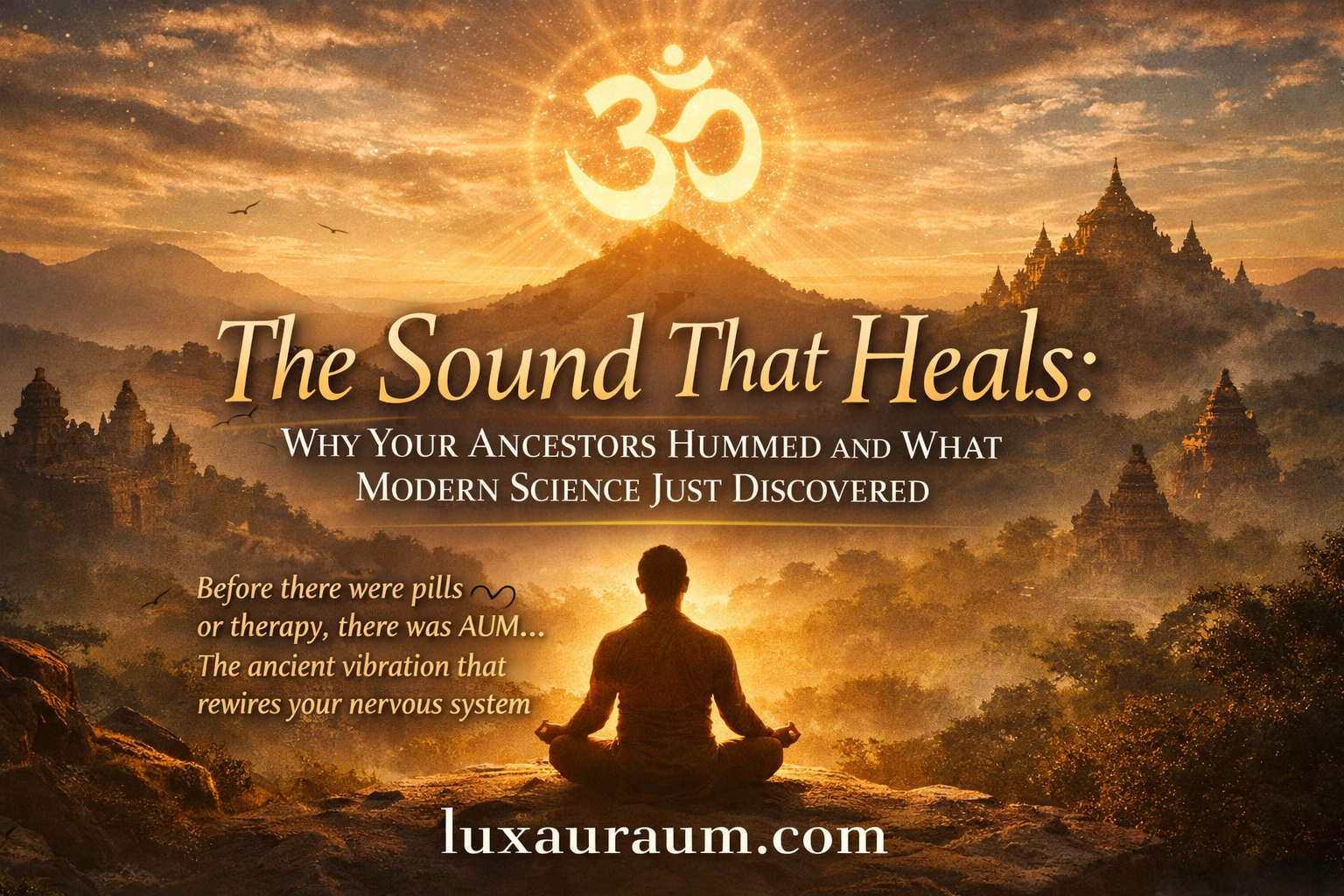
The Ancient Science of Humming: Why the Ancients Chanted AUM and How It Rewires Your Nervous System
Before there were pills, before there were therapists, before there was any medicine you could buy in a bottle—there was sound. Not music. Not words. Vibration. The hum. The Om. The breath turned into tone.
The ancients didn't know about the vagus nerve. They didn't know about heart rate variability. But they knew. They knew because they felt it. And now, thousands of years later, science is finally catching up.
Your mind races. Your body is tense. You've tried meditation, but sitting still feels impossible. You've tried breathing exercises, but they feel mechanical, forced. You want something simple. Something you can do anywhere. Something that works without requiring you to empty a mind that refuses to be emptied.
There is an answer. It's been hiding in plain sight. It's the sound your grandmother made when she was content. It's the vibration that rises in your chest when you're wordlessly happy. It's the hum.
The ancients built entire spiritual systems around this sound. They called it AUM. They called it the primordial vibration. They called it the sound of creation.
They were not being poetic. They were being precise.
Humming—whether Om, AUM, or any sustained tone—is not just soothing. It is physiological medicine. The vibration stimulates the vagus nerve, the longest nerve in your body, which runs from your brainstem to your abdomen. When the vagus nerve is activated, your heart rate slows, your blood pressure drops, your stress hormones decrease, and your body shifts from "fight or flight" to "rest and digest."
The ancients discovered this through observation. Science has now confirmed it through measurement. The mechanism is real. The effects are measurable. And the practice is free.
THE VAGUS NERVE—THE HIDEN HIGHWAY
The vagus nerve is the tenth cranial nerve. Its name comes from the Latin word for "wandering," and it wanders indeed—from your brainstem, down through your neck, branching to your heart, your lungs, your digestive tract .
It is the primary highway of your parasympathetic nervous system—the "rest and digest" system that counteracts stress. When the vagus nerve is activated, it tells your heart to slow down, your blood vessels to relax, your digestion to begin, and your stress response to shut off .
But here's the crucial point: you cannot consciously tell your vagus nerve to activate. You cannot simply think "calm down" and expect your nervous system to obey. Your conscious mind does not have direct access to this pathway.
Your vocal cords do.
The muscles of your larynx, pharynx, and soft palate are directly connected to the vagus nerve. When you hum, sing, chant, or even gargle, you are physically stimulating these muscles—and the vibration travels up the vagus nerve to your brainstem, triggering a cascade of calming effects throughout your entire body .
This is not subtle. This is not placebo. This is anatomy.
THE SCIENCE OF OM—WHAT THE RESEARCH FOUND
The ancient yogic tradition identified Om (or AUM) as the most sacred syllable—the "primordial sound" from which all creation emerged. The Mandukya Upanishad devotes its entire text to the meaning of this single syllable, describing it as the essence of all speech, the three states of consciousness (waking, dreaming, deep sleep), and the transcendent fourth state beyond them .
Modern science has now measured what the sages experienced.
A comprehensive review published in 2025 examined 21 studies on Om chanting and found that it produces measurable beneficial effects on multiple body systems:
- Brain activity modulation (changes in neural patterns associated with relaxation)
- Parasympathetic activation (increased vagal tone)
- Reduced stress (lower cortisol levels)
- Lower blood pressure
- Reduced inflammatory biomarkers
- Improved memory and emotional processing
- Pain reduction
The review concluded that Om chanting is "a safe, feasible, and cost-effective intervention" with no adverse effects .
In other words: free, harmless, and effective.

THE THREE SOUNDS, THE THREE EFFECTS
Om is traditionally divided into three sounds: A, U, and M.
The "A" sound (Ah) — produced in the throat, vibrating the upper vagus pathways. Associated with the waking state. Grounding, activating, alerting.
The "U" sound (Ooh) — moving to the back of the mouth, vibrating the palate. Associated with the dream state. Soothing, flowing, balancing.
The "M" sound (Mmm) — the hum, the vibration that fills the head and chest. Associated with deep sleep. Calming, deepening, integrating.
The silence after — the fourth state. Transcendence. The space where thought dissolves.
Each component has a distinct physiological effect. But the humming—the sustained "M"—is where the vagal magic happens. The vibration travels through your sinuses, your skull, your chest. It stimulates mechanoreceptors that send signals directly to your brainstem. It increases the production of nitric oxide in your nasal passages, which dilates blood vessels and improves circulation .
One sound. Multiple effects. All beneficial.
THE STRESS INDEX STUDY—HARD DATA
In 2023, researchers conducted a study comparing the effects of humming (specifically Bhramari pranayama, or "humming bee breath") against physical activity, emotional stress, and sleep .
The results were striking: humming generated the lowest stress index of all four activities. Not just lower than stress (obviously). Lower than sleep. Lower than physical activity.
The researchers measured heart rate variability (HRV)—the variation in time between heartbeats, which is a direct marker of vagal tone. Higher HRV indicates better stress resilience, better emotional regulation, and faster physiological recovery from challenges.
Humming improved HRV significantly. The study concluded that a regular daily humming routine can "enhance the parasympathetic nervous system and slow down sympathetic activation"—in plain English: it makes your body's "brake pedal" stronger and its "gas pedal" weaker .
THE BRAIN—DEFAULT MODE NETWORK AND THE QUIETING OF THE MIND
Your brain has a system called the Default Mode Network (DMN) . It's active when you're not focused on anything external—when you're daydreaming, ruminating, worrying, or replaying past conversations in your head .
An overactive DMN is associated with anxiety, depression, and a scattered, restless mind.
Research has shown that chanting Om significantly deactivates the DMN. The same study found that the simple act of repeating a word—any word—can reduce DMN activity, but Om appears to have unique properties due to its specific vibrational frequency .
The "A" sound activates. The "U" sound balances. The "M" sound settles. The silence deepens.
This is not superstition. This is neuroimaging.
WHAT THIS MEANS FOR YOU—A PRACTICE
You do not need to be Hindu. You do not need to be Buddhist. You do not need to believe anything. You just need to be willing to make sound.
The Basic Practice:
Find a comfortable seat. Back straight but not rigid. Close your eyes. Take a deep breath. On the exhale, chant "Om" (or simply hum). Let the sound vibrate in your chest. Feel it in your throat. Notice it in your sinuses. Continue for 5-10 minutes.
For Stress Relief (Immediate):
When you feel anxiety rising, hum. Not in your head—out loud. Even quietly. Even under your breath. The vibration does not need to be loud. It needs to be felt. Hum for 30-60 seconds. Notice what shifts .
For Sleep:
Chant Om before bed. The vibration slows neural activity and helps transition from wakefulness to sleep. The ancient practice of chanting before rest was not ritual—it was physiology .
For Focus:
The "A" sound (Ah) is activating. Chant it before tasks requiring alertness. The "M" sound (Mmm) is settling. Chant it before tasks requiring patience.
For Nausea:
The vagus nerve also connects to your digestive system. Humming may help reduce nausea by stimulating the "rest and digest" response in your gut .
WHY THE ANCIENTS KNEW
The ancients did not have heart rate variability monitors. They did not have fMRI machines. They did not know the words "vagus nerve" or "parasympathetic nervous system."
But they observed. They practiced. They transmitted.
For thousands of years, yogis, monks, and mystics have chanted Om. They described it as the sound of the universe, the primordial vibration, the syllable that contains all syllables. They built elaborate philosophies around its three sounds and the silence that follows .
They were not wrong. They were just speaking a different language.
Where we say "vagal tone," they said "prana." Where we say "parasympathetic activation," they said "sattva." Where we say "heart rate variability," they said "balance."
Same phenomenon. Different vocabulary. The West is still catching up.
You have been given a tool. It costs nothing. It requires no equipment. It can be done anywhere, anytime, without anyone knowing. It is older than any religion, any philosophy, any written word.
It is the sound of your own breath turned into vibration.
The ancients knew. They built temples to this sound. They wrote scriptures about this sound. They staked their spiritual lives on this sound.
They were not foolish. They were not primitive. They were observant.
They noticed that when they hummed, their hearts slowed. When they chanted Om, their minds settled. When they vibrated their vocal cords in a sustained tone, something shifted in their bodies—something they could not see but could certainly feel.
Now we know what that something is. We can measure it. We can quantify it. We can prove it.
But the proof was never the point. The experience was the point. And the experience has been available to every human being who ever drew breath.
The question is not whether humming works. The question is whether you will use what you now know.
The sound is waiting. Your breath is ready. Your vagus nerve is listening.
What will you chant today?





Collective Insights
Be the First to Share
Your insights could spark meaningful conversations. Share your thoughts above!
Share Your Insight