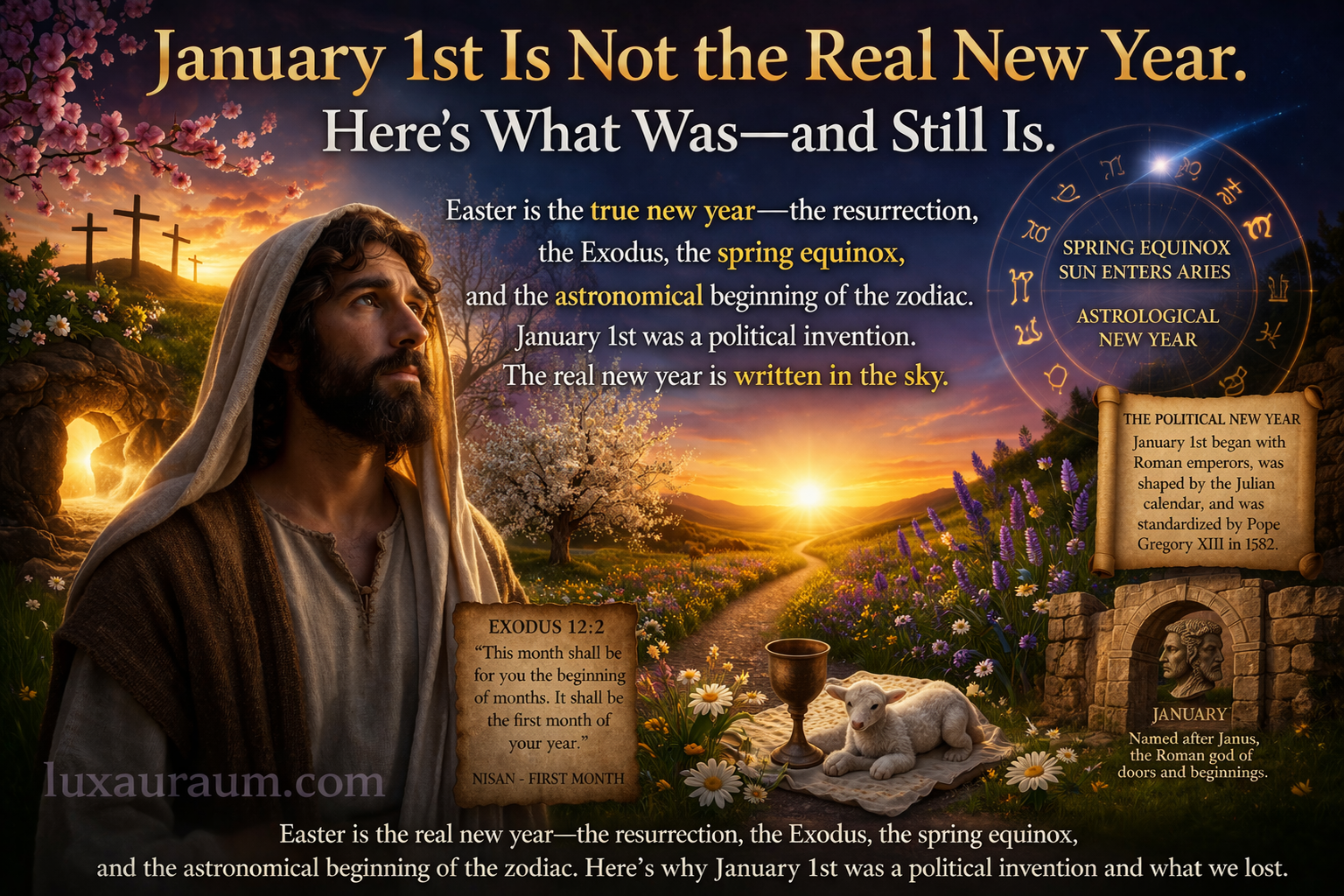
January 1st is not the real new year. It never was. It's a political invention from Roman emperors and medieval popes. The true new year falls in March—at the spring equinox, at Easter, at Passover, at the resurrection of Christ, at the Exodus from Egypt, and at the beginning of the zodiac.
The earth knows when the year begins. The stars know. The ancient scriptures know. The only one that forgot was the calendar on your wall.
You celebrate New Year's on January 1st. You make resolutions. You feel a sense of fresh start. But something feels off. The resolutions fade by February. The energy doesn't match the season. You're celebrating new life in the dead of winter, while nature is asleep.
Meanwhile, Easter comes—and something actually shifts. The air changes. The light returns. There's a feeling of real beginning, real resurrection, real hope. You've felt it but couldn't explain it.
Here's the truth that changes everything:
Easter is the real new year. It marks the resurrection of Christ, the Exodus of the Israelites from Egypt, and the spring equinox—the astronomical moment when day and night balance and light begins to overcome darkness. January 1st was a political invention. The true new year is written in the sky.
WHAT THE BIBLE ACTUALLY SAYS—NISAN IS THE FIRST MONTH
The Bible is explicit about when the year begins. Not January. Not December. Not September.
Exodus 12:2 records God speaking to Moses and Aaron in Egypt, on the eve of the first Passover:
"This month shall be for you the beginning of months. It shall be the first month of your year."
The month was Abib (later called Nisan), which corresponds to March-April in the modern calendar . God reset the calendar. He took Israel out of Egypt's time system and gave them their own—a calendar that begins in spring, with the Exodus as the defining event.
This was not arbitrary. The month of Nisan is the month of:
- Spring (the Hebrew word "Abib" means ripening barley—the first harvest)
- The Exodus (God delivered Israel from slavery on the 15th of Nisan)
- Passover (the sacrifice of the lamb that saved the firstborn)
- Miracles (the word nes means miracle; Nisan is the month of miracles)
The Talmud (Rosh Hashanah 1:1) teaches that there are four "new years" in the Jewish calendar, but Nisan is the first—the head of months, the sacred new year, the one that God Himself established .
The civil new year (Rosh Hashanah) falls in the seventh month, Tishrei (September-October). But the spiritual new year—the one that marks redemption, liberation, and new life—is Nisan. It is spring. It is the Exodus. It is the beginning.
THE RESURRECTION—CHRIST AS THE FIRSTFRUITS
The New Testament explicitly connects Jesus' resurrection to the Jewish calendar and the spring harvest.
1 Corinthians 15:20 calls Christ "the firstfruits of those who have fallen asleep." Firstfruits (bikkurim) was the festival of the first barley harvest, celebrated on the day after the Passover Sabbath—which is exactly when the resurrection occurred .
Jesus was crucified on Nisan 14 (Passover), buried before Nisan 15 (Unleavened Bread), and rose on the day after the Sabbath during the week of Unleavened Bread—which is the day of Firstfruits .
The pattern is precise:
- Nisan 14: Passover lamb is slaughtered → Christ crucified
- Nisan 15-21: Feast of Unleavened Bread → Christ in the tomb
- Day after the Sabbath during Unleavened Bread: Firstfruits → Christ resurrected
The resurrection is not just a historical event. It is the fulfillment of the agricultural and spiritual calendar. It is the moment when the new harvest begins. It is the new year of the soul.
The apostle Paul explicitly makes this connection (1 Corinthians 5:7): "Christ, our Passover lamb, has been sacrificed."
The resurrection is the Exodus of the soul. Just as Israel was liberated from slavery in Egypt in Nisan, Christ liberates humanity from sin and death in Nisan. Same month. Same God. Same redemption.
THE ASTRONOMICAL NEW YEAR—SPRING EQUINOX
The spring equinox occurs every year between March 19-21 in the Northern Hemisphere. On this day, the sun crosses the celestial equator, and day and night are equal in length. After this day, light begins to overcome darkness. Days grow longer. Nights grow shorter. The earth awakens.
This is the astronomical new year. It is the moment when the cycle of life, death, and rebirth begins again .
The astrological new year falls on the same day: the sun enters Aries, the first sign of the zodiac . The word "Aries" means ram—the same animal that was sacrificed in place of Isaac, the same animal whose horns are mentioned throughout scripture. The ram is the symbol of the spring equinox.
The ancient world knew this. The Persian festival of Nowruz (meaning "new day") is celebrated on the spring equinox. It has been observed for at least 3,000 years and is recognized by UNESCO as an "intangible heritage of humanity" . Countries from Iran to Turkey to Afghanistan celebrate the true new year in March—not January.
The Christian world preserved this without knowing it. Easter is always the first Sunday after the first full moon after the spring equinox . The date moves, but it always clusters around the equinox. Easter is the Christian Nowruz. It is the resurrection of the land and the resurrection of the Lord.
The Jewish world preserved this as well. Passover is on the 15th of Nisan, which is always a full moon, always after the equinox. The spring full moon is the signal: the time of liberation has come.
THE STAR OF BETHLEHEM—JESUS BORN IN SPRING, NOT WINTER
Christians celebrate Christmas on December 25th. But the evidence suggests Jesus was almost certainly not born in winter.
The Gospel of Luke (2:8) records that shepherds were "living out in the fields, keeping watch over their flocks at night." In Israel, shepherds bring their flocks indoors during winter (December-February). The fields are cold, the grass is scarce, and the nights are harsh. Shepherds are not out in the fields in December .
Shepherds are in the fields during spring—the lambing season, when grass is abundant after the rains, when the weather is mild. This is March-April. This is Nisan.
The Star of Bethlehem points to the same conclusion. Chinese astronomers recorded a "broom star" (a comet) in the spring of 5 BC, visible for 70 days . Other scholars point to a rare triple conjunction of Jupiter and Saturn in 6 BC, with a heliacal rising on April 17 .
The Magi were not kings. They were astrologers—Zoroastrian priests from Persia who watched the sky for signs of cosmic significance. They would have recognized the spring equinox as the new year and a conjunction of royal planets (Jupiter) with the first sign of the zodiac (Aries) as the birth of a king .
The most likely date for Jesus' birth is March-April of 5-6 BC. Not December. Not 1 AD. The monk Dionysius Exiguus miscalculated the calendar in the 6th century, and his error became standard .
This means: Jesus was likely born during Nisan—the month of the Exodus, the month of the Passover lamb, the month of new life. His birth, his death, and his resurrection all cluster around the same season: spring. The beginning, the middle, and the end of his earthly life all point to the same truth: this is the season of redemption.
HOW JANUARY 1ST STOLE THE NEW YEAR
If the true new year is March, how did January 1st become the standard?
The answer is Roman politics.
The Roman republican calendar originally had ten months, beginning in March. September (septem=7), October (octo=8), November (novem=9), December (decem=10) were indeed the 7th through 10th months—which is why their names don't match their positions .
Around 715 BCE, King Numa Pompilius added January and February to the end of the calendar. But January (named after Janus, the Roman god of doors and beginnings) eventually became the first month .
In 46 BCE, Julius Caesar introduced the Julian calendar. He retained January 1st as the new year, partly to honor Janus and partly for political convenience .
When the Roman Empire fell, Christian countries tried to change the new year back to more religious dates—March 25th (Feast of the Annunciation) and December 25th (Christmas) were both used .
But in 1582, Pope Gregory XIII introduced the Gregorian calendar. He solved the leap year problem, but he also restored January 1st as the official new year . Protestant and Orthodox nations resisted for centuries, but eventually, January 1st became the global standard—not because it was right, but because it was convenient for tax collection, administrative uniformity, and Roman tradition .
January 1st is a civil holiday, not a cosmic one. It is political, not astronomical. It is administrative, not spiritual. It is the new year of empire, not the new year of the soul.
THE SYNTHESIS—WHAT WE LOST AND HOW TO GET IT BACK
When the new year moved from spring to winter, something shifted. Not in the stars—they still turn. Not in the earth—it still wakes. But in human consciousness.
The spring new year is a visible, tangible, felt reality. You can see the days lengthening. You can smell the earth thawing. You can feel the energy rising. The resurrection is not just a doctrine—it is a phenomenon.
The winter new year is abstract. It is a date on a calendar. It requires no observation of nature, no participation in the cosmos. You can celebrate it in a basement with no windows and feel nothing of the turning of the world.
The early church knew this. Easter was the central festival, not Christmas. The resurrection was the defining event, not the birth. The spring was the season of salvation.
The Jewish people preserved this. The month of Nisan is still the first month. Passover is still the defining holiday. The spring is still the time of liberation.
The astrological tradition preserved this. The sun entering Aries is still the astrological new year, still celebrated as Nowruz across Asia, still recognized as the true beginning of the zodiacal cycle .
January 1st is not the real new year. It never was. It's a political invention from Roman emperors who wanted to honor a god of doors, a Pope who wanted to standardize tax collection, and a calendar that lost its connection to the sky.
The true new year is now. It is spring. It is the equinox. It is the resurrection. It is the Exodus.
Nisan is the first month—the month of miracles, the month of liberation, the month of the Passover lamb, the month of the firstfruits harvest .
The spring equinox is the astronomical new year—when light begins to overcome darkness, when the earth awakens, when the cycle of life restarts .
Easter is the Christian new year—the resurrection of Christ, the defeat of death, the promise of new life .
These are not separate events. They are the same event, languages, different traditions, different calendars. The Exodus. The Equinox. The Resurrection. One liberation. One light. One new year.
You have been celebrating the wrong new year. Not because you were wrong—because you were told the wrong story. But the story is still there, written in scripture, written in the stars, written in the soil.
This March, when the equinox comes, when the full moon rises, when Easter approaches—remember. This is the real new year. The one that actually means something. The one that the earth still keeps, whether the calendar admits it or not.
What will you begin this spring—the season of real new beginnings?
Sources cited:
- Exodus 12:2 (Torah)
- 1 Corinthians 5:7, 15:20 (New Testament)
- Talmud (Rosh Hashanah 1:1)
- Zohar (teachings on Nisan)
- Babylonian Talmud (Sanhedrin 12a-13b)
- Britannica (history of January 1st)
- Chabad (Nisan facts)
- Daily Mail (scientific dating of Jesus' birth)
- Vogue (astrological new year)
- Astrolink (spring equinox as new year)



Collective Insights
Be the First to Share
Your insights could spark meaningful conversations. Share your thoughts above!
Share Your Insight