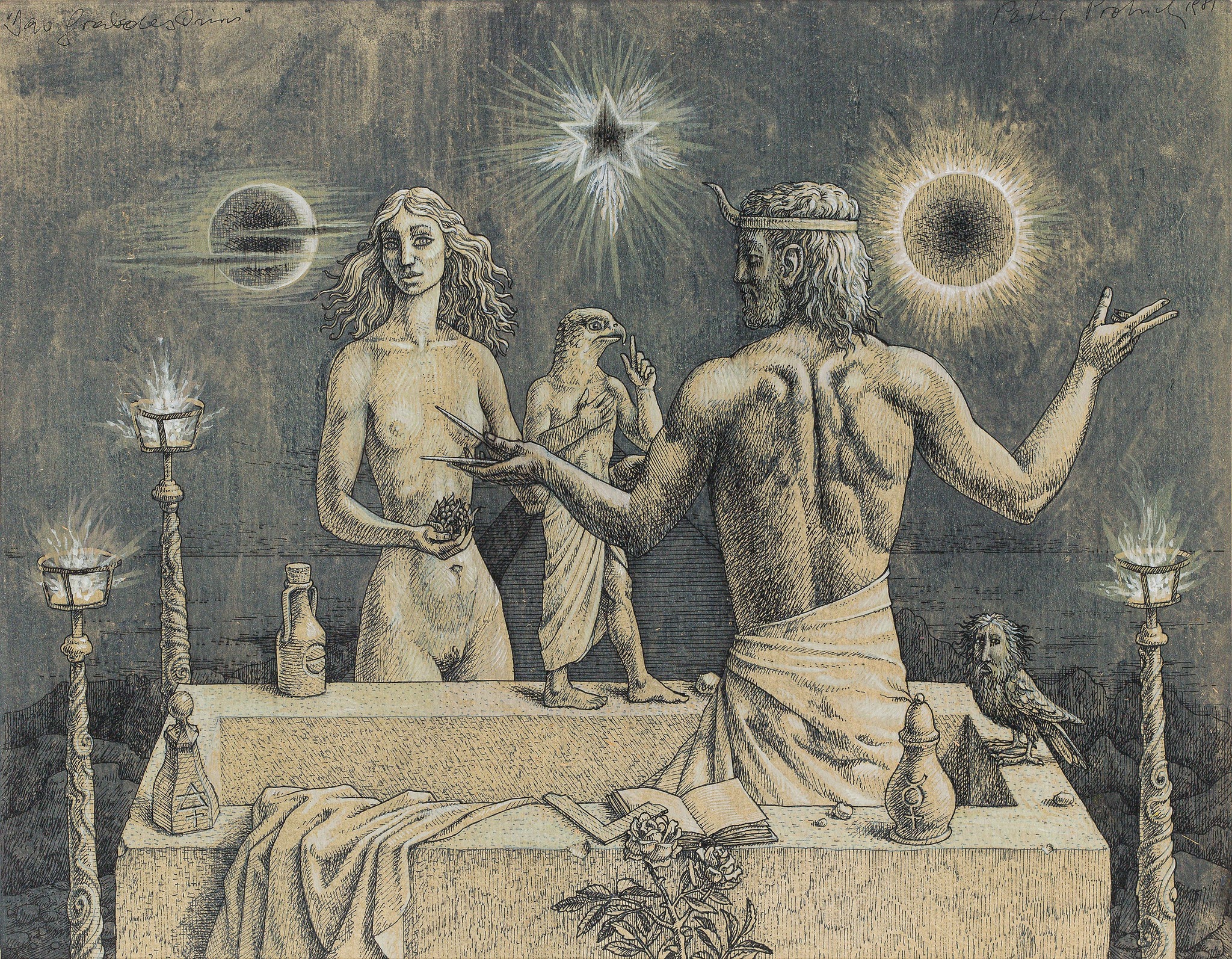
Image caption: "The Tomb of Osiris", 1981 by Peter Proksch
Introduction: A Myth That Never Dies
Let’s be brutally clear about something most Egyptologists won’t say:
Osiris never existed.
Not as a green-skinned god-king who walked the earth. There is zero archaeological evidence for a historical Osiris. Yet, for over five millennia, his story has refused to die. It has shaped civilizations, religions, and the deepest psychological structures of the West.
Why?
Because the Tomb of Osiris is not a place in the sand. It is the first detailed architectural blueprint of the traumatized human psyche, and the ritual instructions for its reassembly. The Egyptians weren’t preserving a corpse; they were mapping consciousness in a language of myth so potent it still operates on us today.
This isn't archaeology. It's cognitive archaeology—the excavation of the ideas that built the human mind. The tomb is real. It’s just not where you’ve been looking. It’s inside your skull.
Historical Origins: The Myth That Built Civilization
The Core Narrative: More Than a Divine Soap Opera
The myth is deceptively simple: Osiris, the wise, fertile king, is murdered by his chaotic brother Set. Set dismembers the body into 14 (or 42) pieces and scatters them across Egypt. Osiris’s wife-sister Isis, the archetype of devoted consciousness, searches for every fragment. She recovers all but the phallus, which she fashions anew. Through ritual and magic, she reassembles Osiris, who is resurrected—not as ruler of the living world, but as lord of the underworld (Duat) and judge of the dead. His posthumous son, Horus, then avenges him and assumes the earthly throne.
This is not a primitive tale of jealousy. It is a pre-literate case study in psychological disintegration and integration.
The "Discovery" of the Tomb: Politics as Spiritual Theater
Herodotus and later classical writers speak of the "Tomb of Osiris" at Philae or Abydos. The Osireion at Abydos, a massive subterranean structure built by Seti I, was likely a ritual simulation center. It wasn't built to house a body, but to stage the myth for initiates.
Here’s the historical truth they mask: The so-called "discovery" of Osiris’s relics by various pharaohs was always a political-psychological operation. By "finding" the god’s body parts, a ruler was symbolically performing the role of Isis—re-integrating the fractured body politic of Egypt itself. The ritual proclaimed: "I am the consciousness that can find the lost pieces and make the nation whole again."
The tomb was never lost. It was perpetually rediscovered because its true function was ongoing psychic theater, not static burial.
Symbolism and Hidden Meaning: The Anatomy of a Shattered Self
Every detail of the myth is a precise symbol for a psychological process. The secrecy wasn't to hide power from the masses, but to protect the integrity of the therapeutic metaphor.
The Dismemberment: Traumatic Fragmentation
The 14 pieces of Osiris do not correspond to random body parts. They map to core psycho-spiritual faculties.
- The Head (Intelligence/Witness): Severed from the body of feeling.
- The Heart (Center of Will/Identity): The crucial organ weighed in the afterlife judgment.
- The Phallus (Creative Life-Force): The "lost" piece—representing the perennial feeling after trauma that one's generative power is gone, irrecoverable.
Dismemberment is the universal metaphor for psychic shattering—the experience of trauma, betrayal, or profound loss that fragments the coherent self into isolated, dysfunctional parts. Set is not just "evil"; he is the principle of entropy, chaos, and violent disruption necessary to break a rigid, perhaps complacent, structure (Osiris’s kingdom).
The Search & Reassembly: The Isis Principle
Isis represents attentive, loving consciousness. Her search is not frantic, but meticulous. This is the process of therapy, integration, and shadow work. Gathering the pieces is:
- Recognition: Acknowledging the fragmented parts (denied grief, frozen anger, abandoned creativity).
- Recovery: Retrieving them from the "Nomes of Egypt"—the various forgotten or dissociated corners of one's life and memory.
- Reconstruction: The painstaking work of putting the self back together in a new configuration.
The crafted phallus is the critical symbol: What is lost in trauma cannot be recovered as it was. It must be re-created, re-imagined at a higher level. The new self is not a repair job; it is an act of profound creativity.
The Tomb/Underworld: The Subconscious Basin
The Tomb of Osiris is the Duat—the Egyptian underworld. In psychological terms, the Duat is the subconscious and the body. It is where dismembered parts live, where the unintegrated memories and drives reside. Osiris rules here not as a dead king, but as the integrating principle that brings order to the internal chaos. To "enter the tomb" is to descend into one's own subconscious for the purpose of re-organization.
Consciousness / Psychology Explanation: The Neuroscience of Dismemberment and Re-Membering
The myth of Osiris is a shockingly accurate model of post-traumatic growth and neural reintegration.
Trauma and the Shattered Brain
Severe psychological trauma doesn't just create bad memories. It disrupts the normal, integrated functioning of the brain.
- The hippocampus (memory integrator) can shrink, isolating memories.
- The amygdala (fear center) becomes hyper-reactive.
- Communication between the left (logical, linguistic) and right (emotional, holistic) hemispheres can be impaired.
This is literal neuropsychological dismemberment. The coherent "I" is fragmented into sensory flashbacks (body pieces), emotional dysregulation (scattered organs), and cognitive dissonance (the lost phallus of meaning).
The Isis Process: Neural Integration Therapy
Modern therapies for trauma—like Somatic Experiencing, EMDR, or Internal Family Systems (IFS)—are the methodological children of the Isis ritual.
- Finding the Pieces: In IFS, this is identifying "exiled parts"—fragmented emotional states frozen in time.
- Reassembling with Love: The therapeutic relationship (the Isis consciousness) provides the safe, attuned presence that allows neural pathways to rewire.
- The Crafted Phallus: This is post-traumatic growth—the documented phenomenon where survivors rebuild a world of meaning that is often richer and more resilient than their pre-trauma state. The new organ is not the old one; it's better adapted.
The "resurrection" of Osiris is not a return to his old life. It's the achievement of a new, stable state of consciousness that can contain and rule over the once-chaotic underworld of the psyche. He is the integrated Self that can preside over the multitude of subconscious impulses (the "dead") with judgment and order.
Why It Feels Real: The Body Keeps the Score, The Myth Holds the Script
The reason this 5,000-year-old story feels more "true" than modern psychology textbooks is that it works on the level of somatic metaphor.
- Embodied Cognition: We don't just think with our brains; we think with our bodies. The feeling of being "torn apart" or "in pieces" after a loss is a real somatic experience. The myth gives that feeling a story, making it comprehensible and, therefore, manageable.
- Narrative Coherence: Trauma destroys one's life narrative. The Osiris myth provides a pre-made, coherent narrative arc from integrity, through disintegration, to a higher re-integration. Adopting this archetypal narrative is itself therapeutic—it restores order to chaos.
- Ritual as Somatic Therapy: The annual "Mysteries of Osiris," where his death and resurrection were re-enacted, were not mere plays. They were community-wide somatic experiencing sessions. Participants didn't just watch Osiris be reassembled; through ritual action, song, and procession, they physically enacted the reintegration of their own social and psychological bodies after the "death" of the annual cycle.
Modern Relevance: From Cults to Corporations—The Osiris Code Runs Everything
The pattern of death, dismemberment, search, and reconstitution is the core algorithm of transformation. It’s running your life and your world right now.
The Corporate Osiris
Modern branding and marketing are applied Osirian mythology.
- Dismemberment: Culture fragments your identity into consumer categories (athlete, parent, professional, rebel).
- The Search: Brands position themselves as the "Isis"—the solution that can help you "find yourself" or "reclaim your true potential."
- The Crafted New Self: You are sold the new phallus (iPhone, car, degree) as the key to your reconstituted, superior identity. You don't buy the product; you buy the re-membered self.
Technological Resurrection
The transhumanist dream of uploading consciousness is the ultimate Osirian fantasy: the physical body (the old, corruptible Osiris) is dismembered by death, but the "pattern" (the data-self) is reassembled in the silicon Duat of the cloud. We are literally trying to build the tomb that Osiris rules—a digital underworld for consciousness.
Healing in the 21st Century
The most effective modern therapeutic modalities have unknowingly rediscovered the Osiris ritual.
- Psychedelic-Assisted Therapy: The psychedelic experience often involves a symbolic "dismemberment" of the ego (the Osiris death), followed by a profound sense of visceral re-integration at a higher level (resurrection).
- Therapy Itself: The therapist occupies the Isis position—the holding, searching, non-judgmental consciousness that helps the client find and reassemble their parts.
FAQs: The Tomb’s Truths
Q1: Where is the real Tomb of Osiris?
A: There is no single archaeological site. The "real" tomb is a psychological and ritual construct. Major cult centers like Abydos contained symbolic tombs (the Osireion) designed for initiatory drama. The tomb’s true location is the ritual space where an individual or community enacts the myth of disintegration and reintegration.
Q2: Was Osiris based on a real person?
A: Almost certainly not. He is a mytho-poetic composite, possibly originating in prehistoric funerary rituals for chieftains. His "history" was a retroactive projection, a common process where archetypal myths are later historicized to lend them authority.
Q3: What is the significance of the 14 pieces?
A: The number varies (14, 16, 42). The commonality is systematic fragmentation. Fourteen may correspond to the number of Nomes (provinces) of Egypt, symbolizing the totality of the kingdom/self being scattered. The key is not the count, but the process of total deconstruction.
Q4: Is this just a metaphor for the agricultural cycle?
A: That is the exoteric, surface-level reading (seed buried/death, plant grows/rebirth). The esoteric, psychological reading is far more powerful and enduring. The agricultural metaphor is the container for the human experience metaphor. We used the cycle we saw in nature to understand the cycle we felt in our souls.
Q5: How is this different from the Jesus resurrection story?
A: The Osiris myth is psychological and cyclical (it happens annually in nature and ritually). The Christ story is historical and linear (it happens once in history, with cosmic stakes). Both are archetypes of death and rebirth, but Osiris is fundamentally about the process of integrating the fragmented self, while Christ is about the transcendent salvation of the self. One is a map of therapy, the other a map of theology.
Q6: Can engaging with this myth be dangerous?
A: Any deep psychological work carries risk. Engaging with the dismemberment archetype without the Isis principle (loving, structured support) can lead to further fragmentation or existential terror. It should be approached with respect, ideally with guidance (a therapist, a skilled ritual group, or deep personal preparedness), not as a casual intellectual exercise.
Q7: How can I apply this knowledge to my life?
A: Use it as a diagnostic and narrative tool.
- When you feel "in pieces," name it: "This is my Osiris moment. Set has acted."
- Embody Isis: Approach your fractured feelings not with panic, but with curious, loving attention. Journal. "Where did this piece of my anger come from? Where has it been hiding?"
- Accept the need for a "crafted phallus": Understand that after a major loss, you will not get the old you back. You are tasked with creating a new version that incorporates the loss into your strength.
Conclusion: You Are the Tomb, the Corpse, and the God Who Rises
Here is the ultimate reframing, stripped of all antiquity:
The Tomb of Osiris is the default state of the modern mind.
We are all, daily, dismembered—by the chaos of information (Set), by trauma, by the sheer entropy of life. Our parts are scattered across the digital Nomes of social media, professional identity, and curated personality.
The ancient Egyptians didn't worship a dead god. They diagnosed the human condition and prescribed the cure in the most memorable format possible: a divine soap opera.
The call is not to find a tomb in Egypt. The call is to become the tomb, and the god within it. To allow the dismembering chaos, then to take up the role of Isis—your own devoted, searching consciousness—and begin the slow, painful, glorious work of gathering your pieces and assembling a self that can rule the underworld of your own experience.
Osiris does not lie in wait for you to discover him.
You are the dismembered god. The search begins when you stop looking outward for the tomb, and feel the pieces within.


Collective Insights
Be the First to Share
Your insights could spark meaningful conversations. Share your thoughts above!
Share Your Insight